I’ve been wondering lately about why we are so deeply affected by stories about religious martyrs.
I’m guessing it goes back to worshipping bronze age gods and deciding to sacrifice a prized calf or first-born daughter in return for a bountiful crop or success in the battlefield. The person willing to sacrifice their child (or themselves) was doing it for the good of the tribe and we learned to treat them as holy figures. Fast forward a few thousand years and people still go weak for the idea of “he died for our sins”. It seems to have a very powerful effect on their Paleomammalian brain.
I was thinking about the Mormons yesterday and postulating that one of the reasons their particular cult survived was because Joseph Smith was assassinated and martyred. Religious types like nothing more than a martyr.
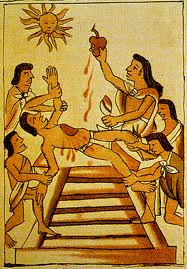
Humanity has had a long fascination with blood sacrifice. In fact, it has been by no means uncommon for a child to be born into this world only to be patiently and lovingly reared by religious maniacs, who believe that the best way to keep the sun on its course or to ensure a rich harvest is to lead him by tender hand into a field or to a mountaintop and bury, butcher, or burn him alive as offering to an invisible God. Countless children have been unlucky enough to be born in so dark an age, when ignorance and fantasy were indistinguishable from knowledge and where the drumbeat of religious fanaticism kept perfect time with every human heart. In fact, almost no culture has been exempt from this evil: the Sumerians, Phoenicians, Egyptians, Hebrews, Canaanites, Maya, Inca, Aztecs, Olmecs, Greeks, Romans, Carthaginians, Teutons, Celts, Druids, Vikings, Gauls, Hindus, Thais, Chinese, Japanese, Scandinavians, Maoris, Melanesias, Tahitians, Hawaiians, Balinese, Australian aborigines, Iroquois, Huron, Cherokee, and innumerable other societies ritually murdered their fellow human beings because they believed that invisible gods and goddesses, having an appetite for human flesh, could be so propitiated. Many of their victims were of the same opinion, in fact, and went willingly to slaughter, fully convinced that their deaths would transform the weather, or cure the king of his venereal disease, or in some other way spare their fellows the wrath of the Unseen.
The Ca$holics of course take it a step further. They literally believe (well, they are supposed to) that they are eating the actual flesh of Jesus when they take communion. Holy Cannibalism, Batman! It’s a wonder there aren’t religions devoted to Hannibal Lecter. Oh no, wait, he’s the eatER, not the eatEE.
So anyway, I’m interested in understanding more about the evolutionary reasons for our fascination with blood sacrifice. If anyone knows anything about it, please educate me. Oh and I’ve started a Branch on the topic, too.
My guest today is Brad Heitmann. Brad lives in Utah, has a background in investment banking and start-up strategy and loves history. Today, however, he joins me to talk about his religion – The Church Of Latter Day Saints aka Mormons. To all those people asking me for years “when are you going to a show about Mormons” – you can now shut the hell up.
Brad and I discuss the life of the founder of the Mormon religion, Joseph Smith – I especially wanted to focus on his trial for being a conman (he was found guilty), his polygamy and the reasons behind his eventual murder. We also discuss the methods by which we search for Truth.
I’d like to thank Brad for having the balls to come on the show. He was a good sport and I hope he takes me up on my offer to come back soon. You can follow him on Twitter @bradheitmann
If you’re interested in the Mormon religion, here’s a few links I recommend:
I’ve been reading some fascinating posts lately on the attempts – past and present – to rig U.S. elections. As with all theories that don’t have sufficient supporting evidence, these need to be read with caution. However, there seem to be enough circumstantial evidence to suggest there might be some element of truth in these stories.
In fact, this article in Harper’s, published weeks before the election and worrying about election rigging in 2012, has stories about elections being rigged in the U.S. as far back as 1932. This same article also explains the connections between the two companies that dominate the electronic voting machine market in the U.S. and their connections to the GOP and the Romney family.
I caught up with a guy for a cigar last night and, as usual, we ended up talking about politics and philosophy. I mentioned that I believe Australians (well…. white Australians) are the luckiest people who have ever lived in all of human history (about 107 billion according to a recent estimate). We are one of the wealthiest countries per capita and live in a country with one of the lowest densities per capita. We have very low unemployment, very low rates of violence and pretty good political stability.
And yet… most people don’t seem to FEEL lucky. They bitch and moan constantly. They have been imbued with this sense that they don’t have enough, they should have more, they aren’t keeping up with the Joneses. It’s a sign of a sick society.
Anyhoo, the point being that we, as the luckiest people who have ever lived, have a responsibility to help out the less fortunate.
Here’s a great video that demonstrates how far we, as a species, have come in the last 200 years.
Today I’m chatting with Jenna Price, one of the key people behind the “DESTROY THE JOINT” movement to stop sexism and misogyny in Australia. Jenna talks about the success of their campaign to get advertisers to pull their funding from the Alan Jones Show on 2GB.
Australia is one of only a few countries in the world that has the facilities to design and manufacture a car from digging the raw materials out of the ground to dealer domestic sale. And in the 1970s Australia’s auto industry was ranked 10th place in the World but today? We are in 28th place.
Take this one example – The Ford Falcon, which has been manufactured since 1960 and is currently on life support. Sales last year were 74% less than its best year ever, which was in 2003.
Ford, which has about 3000 employees in Australia, has received an estimated $1 billion in government subsidies since 2000 in an effort to prop up an industry in decline.
The Labor government has committed $5.4 billion for car making from 2008 to 2020.
Meanwhile – the number of small businesses that went bankrupt last double increased by 48% – and none of them received government handouts. Why? My guess is because there aren’t any votes in it.
To explain why the government is spending billions of our dollars to prop up foreign-owned companies, I’m very pleased to be joined today on Skype, by Nicholas Gruen, all the way from San Francisco, who is a prominent Australian economist, the CEO of Lateral Economics, the Chairman of Peach Financial, the Australian Centre for Social Innovation and Online Opinion, the founding chairman of the Aussie start-up Kaggle, and a board member of Innovation Australia.
You can follow Nicholas on Twitter and check out his new start-up HealthKit.
It has long been my intuition that a country like Australia should welcome refugees – not fear them. I guess this feeling in part comes from my first-hand experiences with immigrants I’ve known over my life, people who came from poverty-stricken countries with political instability and ended up some of the hardest-working, most appreciative Australian’s I’ve ever met. Not only do first generation immigrants work hard, but their children, raised in Australian schools, often with accents broader than my own, tend to grow up with an appreciation of the opportunity Australia represents, continually reinforced by their parents with stories of the “old country”, that is stronger than those of us whose ancestors moved here 100 years or more ago (my mother’s ancestors came to Australia in 1912, from Poland and Britain, my father moved here from Scotland as a “Ten Pound Pom” in the late 60’s).
This research examines what are the economic, social and civic contributions to Australia of first and second generation Humanitarian Program entrants by the analysis of Census data, interviews with families and in-depth discussions with organisations such as employment, education and refugee service providers.
In the introduction summary to the report, they state:
The research found the overwhelming picture, when one takes the longer term perspective of changes over the working lifetime of Humanitarian Program entrants and their children, is one of considerable achievement and contribution.
The Humanitarian Program yields a demographic dividend because of a low rate of settler loss, relatively high fertility rate and a high proportion of children who are likely to work the majority of their lives in Australia.
It finds evidence of increasing settlement in nonmetropolitan areas which creates social and economic benefits for local communities.
Humanitarian entrants help meet labour shortages, including in low skill and low paid occupations.
They display strong entrepreneurial qualities compared with other migrant groups, with a higher than average proportion engaging in small and medium business enterprises.
Humanitarian settlers also benefit the wider community through developing and maintaining economic linkages with their origin countries.
In addition, they make significant contributions through volunteering in both the wider community and within their own community groups.
I wish I heard this perspective being used more liberally in the media and by politicians from all parties when we discuss “The Pacific Solution”. We, as a nation, need to realize that we stand to benefit far more from refugees arriving on our shores than we will need to provide them.
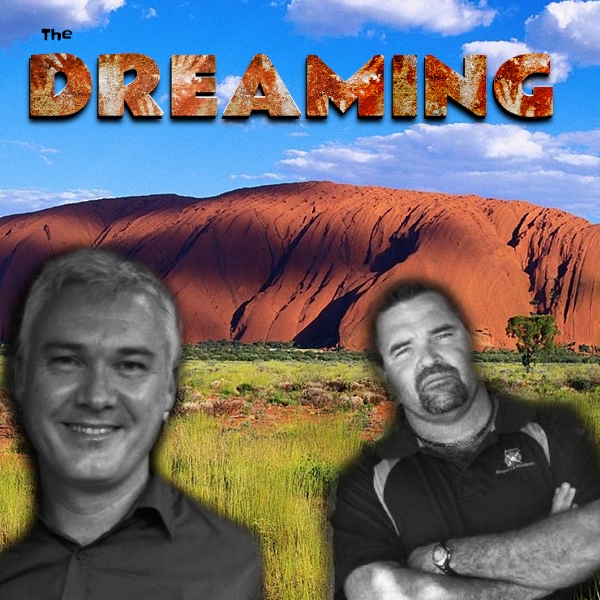
I’ve started a brand new podcast series with David Cole called “The Dreaming”. It’s going to be a long series focused on indigenous affairs. We plan to talk to historians, anthropologists, academics, journalists, politicians, artists and every day people about Australia’s aboriginal people.
I totally endorse this rant by Penn Jillette. Sure, what Mormons (and Scientologists) believe sounds batshit crazy to most of us. But is it really any crazier than what mainstream Christians, Jews or Muslims believe? Hell no. “Just more modern, not more crazy”, as Penn says.
I’m as confused as Penn is about how otherwise intelligent-sounding people can just spout crazy stuff and act like it’s totally normal. It’s especially scary when you hear it from politicians, the people who are supposedly running the country. Surely there should be a sanity test that you have to pass before you can be elected to public office.






 “A Necessary End”
 Buy at

 Buy at