I’m with xkcd
I still feel this way too. Like I’m living in some kind of sci-fi novel.
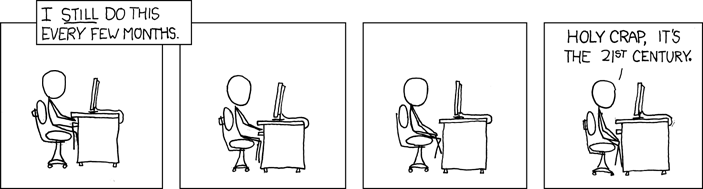
xkcd – A webcomic of romance, sarcasm, math, and language – By Randall Munroe
Blogged with Flock
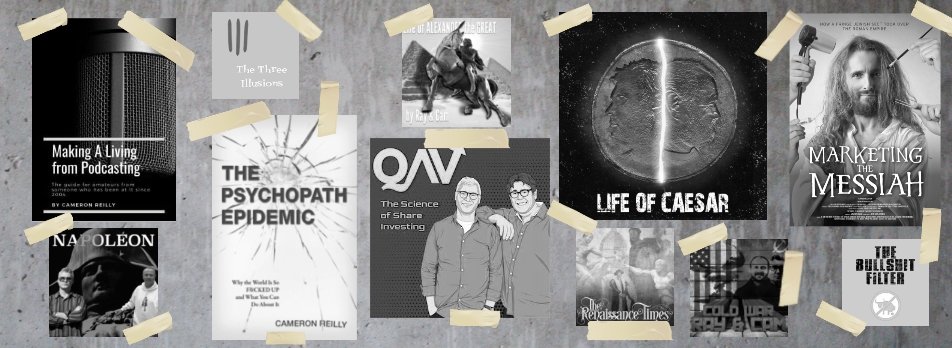
I still feel this way too. Like I’m living in some kind of sci-fi novel.
xkcd – A webcomic of romance, sarcasm, math, and language – By Randall Munroe
Blogged with Flock
We had a massive debate at TPN HQ last night (until my internet access dropped out at midnight and didn’t return) about the subject of free will which was kicked off in a massive twitter debate during the day.
My central postulate was this: if every decision you have is a thought: and if a thought is an autonomous electro-chemical process in the brain: then to claim to have free will, you have to be able to explain how you create a thought outside the process of causality.
The discussion got fairly heated at one point when I (probably wrongly) threatened to eject Dave from The Global Geek Podcast if he kept interrupting me. Sorry Dave, probably harsh. Belinda says I get like that during debates.
Anyway, nobody in the room was able to explain to me how they create a thought except to say “I think them”, which, in my opinion, is a circular argument, because the next question is “how did you decide to think that thought?”.
My other suggestion was that if you are in control of your thoughts, you should be able to stop having them. I suggested everyone in the room stop thinking for ten minutes, and when everyone agreed they couldn’t do that, I asked how they could claim to be in control of the creation of thoughts if they couldn’t stop them at will also? This lead to lots of angst and “but but but” retorts, none of which held any water.
Second Life is a pretty good environment for having discussions like this with people from around the world in real time, although you still suffer from the issue of having 20 people trying to talk at once at times. We need a virtual talking stick to pass around or something. Perhaps someone should create one.
Exactly 90 minutes ago I had an idea. My wife and I were putting our kids to bed and we were doing something we have done with them since they were about two years of age. One of us starts a new story by telling a few lines and then the next person picks up where they left off and so on. I thought “gee, this is like a Twitter conversation” and started to wonder what it would be like to have a bunch of folks on twitter collaborate on a short story – 140 characters at a time.
After I put the kids to bed, I quickly googled to see if anyone had already done something similar and couldn’t see anything (although even if it isn’t 100% original I don’t care, it’ll still be fun), registered the domain name TWITTORIES.com (a twittory is a twitter story), threw together a wiki using wikispaces, and exactly 90 minutes later I am launching it to the world.
The basic idea is that each twittory will last for 140 entries and each entry can be a maximum of 140 characters. Twittory #1, which I have already entitled “The Darkness Inside”, will commence as soon as we have 140 people signed up here and will conclude, no matter where the story is up to, when we have the full 140 entries. 140 x 140 is… a story with a maximum of 19600 characters.
I always knew Marshall McLuhan was onto something…
I listened to a great podcast today. Episode #73 of the Skeptoid podcast. It’s called “Logical Fallacies”. I highly recommend it.
If you’ve ever had a conversation with anyone about their supernatural or pseudoscientific beliefs, you’ve almost certainly been slapped in the face with a logical fallacy or two. Non-scientific belief systems cannot be defended or supported by the scientific method, by definition, and so their advocates turn elsewhere for their support. In this episode, we’re going to examine a whole bunch of the most common logical fallacies that you hear in reference to various pseudosciences. When you hear one that you recognize, be sure to wave and say hello.