by cameronreilly | Mar 26, 2015 | Iraq
When you’re reading the news about ISIL’s bloody campaign to get political control of Iraq, it’s worth keeping in mind another bloody campaign to get political control of Iraq that started 12 years ago, lead by the US, with coalition partners including Australia and the UK.
According to the Iraq Body Count project, the current death toll of the ISIL insurgency since 2011 stands at around 38,000. That’s about 13,000 a year (although the annual number is growing steeply).
Comparatively, Iraq Body Count project found 174,000 Iraqis reported killed between 2003 and 2013, with between 112,000-123,000 of those killed being civilian noncombatants. That works out to about 17,400 a year.
Other sources, such as a Opinion Research Business (ORB) poll conducted August 12–19, 2007, estimated 1,033,000 violent deaths due to the US invasion, or about 258,000 a year for the first four years.
The PLOS Medicine Survey estimated 500,000 deaths in Iraq as direct or indirect result of the invasion from March 2003 to June, 2011, about 62,600 a year.
Of course, all of these figures are speculative, but at first glance, it looks like the Iraqi death toll under ISIL is much lower than it was under the US invasion.
by cameronreilly | Mar 23, 2015 | geopolitics
I’m fascinated to watch how the world’s media is heaping posthumous praise on Lee Kuan Yew and compare it to their depiction of his contemporaries, like Fidel Castro they took power in the same year and are about the same age. Despite many similar aspects of their countries – a clamp down on political dissent, effectively single party rule, harsh treatment of homosexuality, limits on the right of assembly, nepotism, limits on freedom of the press, etc – LKY gets praised, mostly because he turned Singapore into a beacon of capitalism. Castro, on the other hand, has been the subject of continual criticism for 50 years because he threw the capitalists out of the country.
In a glowing obit, the NYT says LKY was “efficient, unsentimental, incorrupt, inventive, forward-looking and pragmatic” and has little negative to say about his authoritarian rule. Instead: “His leadership was sometimes criticized for suppressing freedom, but the formula succeeded. Singapore became an international business and financial center admired for its efficiency and low level of corruption.”
Politicians from around the world are singing his praises.
The lesson? Authoritarian capitalism = good. Authoritarian communism = bad. Even though they both rank highly in the UN Human Development Index, only one of them has been the subject of economic sanction for 50 years. It’s not the authoritarianism that the Western elite have a problem with – it’s what you do with it. If you’re a capitalist, everything else doesn’t matter apparently.
by cameronreilly | Mar 22, 2015 | Uncategorized
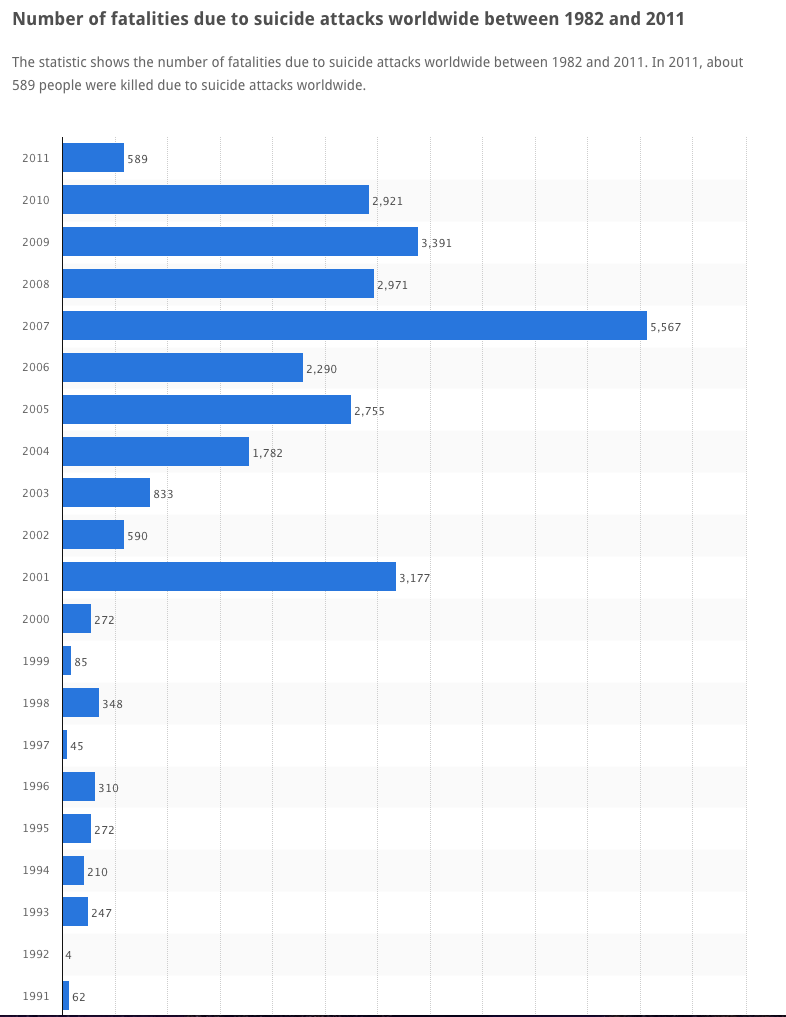
I, for one, am so glad we’ve been fighting over there in the Middle East to end terrorism for the past fifteen years. It seems to be going very, very well, I must say.
(source)
by cameronreilly | Mar 22, 2015 | geopolitics, Iraq
This is a pretty powerful post by Dan Crimmins (aka /u/mopecore), a former American soldier who says he was deployed in “11B from 2002 to 2008. Iraq in 2005, then again in 2007-08, during the Surge. Both tours, we were at distant outposts, (Fob Wilson in 2005, PB Eagle, COP Cahill, and COP Carver in 2007-8)”.
You grew up wanting so bad to be Luke Skywalker, but you realize that you were basically a Stormtrooper, a faceless, nameless rifleman, carrying a spear for empire, and you start to accept the startlingly obvious truth that these are people like you.
His follow up post from a few days ago is also worth reading:
It didn’t occur to me, at the time, that maybe some of their grievances might be legitimate, that they were acting out of fear and a sense of powerlessness as much or than out of hatred. That I bought into the narrative without applying really any critical thought, by giving over to emotional outrage masquerading as righteousness, by assuming the cartoonish media that I consumed had any relation to the real world, I made a mistake, and people died because of it. I’m painfully aware of the man’s tendency towards tribalism, what you describe as the hivemind, the tendency to view everything as my team against your team.
He’s now unemployed, suffering from PTSD, and trying to raise some support funds via GoFundMe.
by cameronreilly | Mar 22, 2015 | geopolitics
Apparently the Australian and US governments are convinced that we each have homegrown terrorists who are planning on carrying out some nefarious deeds on our respective countries. What I want to know is – why aren’t the U.S. drone-bombing Australian and American homes? It’s apparently a perfectly good solution for suspected terrorists in other countries, so why not start with us? Sure – for each suspected terrorist (and it’s important to remember that these people have had no trial to determine their guilt or innocence) they target, somewhere between 15 and 30 innocent civilians are killed. But that’s just acceptable collateral damage, right? As someone said to me on Facebook a couple of days ago, it’s just unfortunate. It’s just unfortunate that we have to kill innocent civilians to save innocent civilians from being threatened by a terrorist who one day might kill… innocent civilians. Right?
Of course, the U.S. aren’t drone bombing suspected terrorists at home or in Australia or the U.K. or Canada. It would be totally immoral to justify killing innocent civilians in order to kill someone who might, one day, kill innocent civilians. Can you imagine scenes like this on our home turf?

So if it is immoral to kill innocent civilians in the hope of hitting a suspected terrorist at home, why is it acceptable to do it overseas?
Because they aren’t us. Because they aren’t white. Because they have a religion we don’t understand. Because they are inferior to us.
If you think it’s acceptable to kill their civilians, but not to kill our own with the same justification, then you must think we are superior to them. We have more rights than they do. And I’m pretty sure that’s the definition of racism.