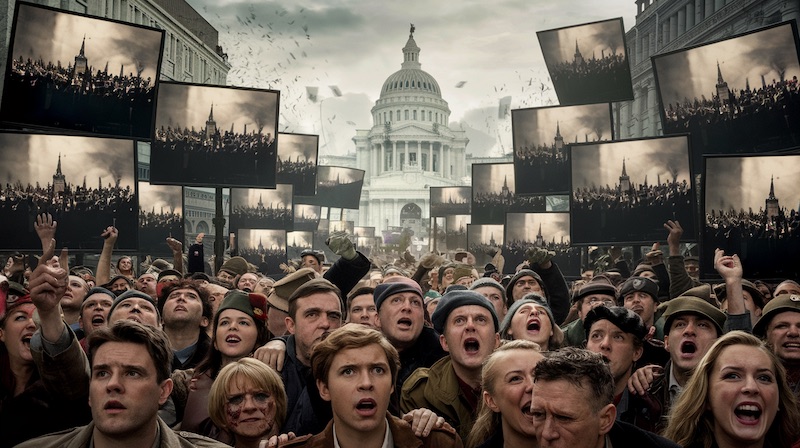
“At the moment that the “normal” police and military resources of the bourgeois dictatorship, together with their parliamentary screens, no longer suffice to hold society in a state of equilibrium — the turn of the fascist regime arrives. Through the fascist agency, capitalism sets in motion the masses of the crazed petty bourgeoisie and the bands of declassed and demoralized lumpenproletariat — all the countless human beings whom finance capital itself has brought to desperation and frenzy.”
Excerpt from Fascism: What it is and how to fight it (1944) Trotsky, Leon
I’ve been thinking about “all the countless human beings whom finance capital itself has brought to desperation and frenzy” and my mind went back to the Occupy Wall Street movement of 2011. Obama’s America.
What did Trump have to say about that at the time?
And what did Mr Hope and Change Obama have to say about them? He said some words. But he tried to play both sides.
“I understand the frustrations that are being expressed in those protests,” Obama said in an interview with ABC News on Tuesday. “The most important thing we can do right now,” he added, is “letting people know that … we are on their side.” When he first expressed sympathy for the Occupy Wall Street movement two weeks ago, Obama added a characteristically cautious qualification: “We have to have a strong, effective financial sector in order for us to grow.”
When the Occupy Wall Street movement was forcibly dismantled by police in late 2011 and into 2012, Obama did not directly intervene to stop the crackdowns. Cities across the country saw coordinated efforts to remove protesters from public spaces, often using riot gear, tear gas, and mass arrests. The Obama administration did nothing. He also did nothing to stop the Supreme Court’s decision on Citizen United, which allowed for unlimited corporate spending in U.S. elections, from becoming law a year earlier.
There was a hunger for someone to provide a message like what Trump is offering—that the cozy Wall Street-Washington nexus cares nothing about them and it is time to take matters into their own hands and reject the blandishments of those who have put them in the state they are in. It was Trump’s genius to be able to understand and articulate that message, and to articulate a message that obliterates the traditional liberal-conservative ideological cleavages.
I don’t think people in the United States are taking the warnings about Trump’s inherent fascist tendencies seriously enough. Why would you hand over power to someone you believe is a fascist? Democracy? They don’t have a democracy over there. They have a plutocracy. And that was true even before Elon Musk bought Trump the election.
I’m reading Michael Mann’s book “Fascists“. That’s Michael Mann the sociologist, not the director of HEAT. One of the defining characteristics of fascism in the twentieth century was their use of a paramilitary.
Since fascists did offer plausible solutions to modern social problems, they got mass electoral support and intense emotional commitment from militants. Of course, like most political activists, fascists were diverse and opportunistic.
Michael Mann – Fascists
So I’m keeping an eye on news stories about American militias, like the Proud Boys and the Oath Keepers. Earlier this year, they seemed to be recruiting again, according to WIRED.
I’m amused that people who support Trump seem to be convinced that everyone who criticises him suffer from “Trump Derangement Syndrome“, when I think they are the ones who are obviously delusional (if not deranged). His supporters claim that people from his first administration that have since tried to warn everyone about his fascist tendencies have an axe to grind.
What axe did Mark Milley, the former Chair of the Joint Chiefs of Staff, have, apart from being disgusted with Trump?
After federal officers and police had used tear gas and other riot control tactics to disperse protestors, during the protests in Washington, D.C., following the murder of George Floyd, saying that he felt “sick” and was “fucking done with this shit” to Esper. Then after Jan 6, he became concerned Trump was preparing to stage a coup, said “this is a Reichstag moment”, and told his associates “They may try, but they’re not going to fucking succeed. You can’t do this without the military. You can’t do this without the CIA and the FBI. We’re the guys with the guns”, referring to Trump’s false statements about electoral fraud as “the gospel of the Führer”. Milley called Trump a “fascist to the core”.
John Kelly, former Chief of Staff, called Trump a “fascist” and criticized his authoritarian tendencies.
James Mattis, former Secretary of Defense, said Trump makes a “mockery of our constitution”.
John Bolton, former National Security Adviser, labeled Trump “unfit to be president”.
Some quotes from Bob Woodward, “Fear – Trump in the White House”:
Gary Cohn, the former president of Goldman Sachs and the president’s top economic adviser in the White House. Cohn and Porter worked together to derail what they believed were Trump’s most impulsive and dangerous orders. “It’s not what we did for the country, ” Cohn said privately. “It’s what we saved him from doing.”
The reality was that the United States in 2017 was tethered to the words and actions of an emotionally overwrought, mercurial and unpredictable leader. Members of his staff had joined to purposefully block some of what they believed were the president’s most dangerous impulses. It was a nervous breakdown of the executive power of the most powerful country in the world.
A senior White House official who spoke contemporaneously with participants in the meeting recorded this summary: “The president proceeded to lecture and insult the entire group about how they didn’t know anything when it came to defense or national security. It seems clear that many of the president’s senior advisers, especially those in the national security realm, are extremely concerned with his erratic nature, his relative ignorance, his inability to learn, as well as what they consider his dangerous views.”
As Staff Secretary, Rob Porter briefed Trump on decision memos and other important presidential documents. In alliance with Gary Cohn, he attempted to block Trump’ s most dangerous economic and foreign policy impulses. Porter told an associate, “A third of my job was trying to react to some of the really dangerous ideas that he had and try to give him reasons to believe that maybe they weren’t such good ideas.”
Let’s not forget the Trump / Epstein relationship:
Jeffrey Epstein, the American financier who was friends with Donald Trump, Bill Clinton, and Prince Andrew, committed suicide in prison under mysterious circumstances. Until 2019, he had managed to avoid much time in jail despite multiple charges of sex trafficking of underage girls going back to 2005 and even a guilty plea in 2008. U.S. attorney Alexander Acosta approved a lenient plea deal for Epstein regarding a case involving prostitution with a fourteen-year-old girl. A decade later, when Acosta was interviewing with Donald Trump’s transition team, he allegedly said he had been told to “back off” Epstein because he “belonged to intelligence.” Acosta went on to become Trump’s Labor Secretary — but resigned when the story about his 2008 deal with Epstein became public.
I impressed myself this week by writing a couple of Python scripts that will create custom news reports for me every day. I used Claude to write them. They will take a list of stocks, either from the weekly buy list that I generate for QAV, or from my portfolios, create RSS feeds for them in Google News Alerts, then download the news items in those feeds. Once it’s downloaded the latest news, it parses it through OpenAI’s API, which removes duplicate stories from different news outlets, then prioritises the news articles based on a list of criteria I’ve given it, ranking the stories from 10/10 (very high importance) to 1/10 (very low importance), then give me a report which I can post to QAV. Here’s an example from today. I wrote this because I’d missed a couple of important events for stocks in my portfolios in recent weeks. I hold over 100 stocks and it’s hard to trawl through all of the news every day.
The key here is that it took me a while to even conceive of the idea of writing a script to do all this for me. The “roll your own” mentality isn’t fully installed in my head yet. But I think within a few years we’ll all get used to having AI just build custom “apps” for us, although we probably won’t even think of them as apps, just “functions”. “Do this for me”. That’ll happen when AI Agents are integrated with our devices and our personal information.
As a lifelong fan of Doctor Who and BTTF, it pains me to have to be the one to point out to people that time travel is probably impossible. It particularly bugs me when I hear scientists talking about it like it’s even remotely possible.
And here’s why.
Most people tend to think of particles (like the ones that make up our bodies) as things that stand alone, like a billiard ball on a table. But that’s not what physics says particles are.
Particles don’t exist in a vacuum. They exist as quantum wave functions in Hilbert space / Spacetime (or perhaps, as Sean Carroll suggests, there’s just a single quantum wave function that makes up the entire universe).
Anyway, I find it helps to think of Spacetime as something more like woven tapestry, especially as we already use the term “fabric” of Spacetime.
The threads (particles) are woven together in a complex pattern, with each one tightly connected to the others around it. What you think of as your body is part of the tapestry. The design of the tapestry is the fabric of spacetime, and the threads can’t just be ripped out and moved elsewhere without unraveling the whole pattern. If you were to take one thread (a particle), it wouldn’t be able to reinsert itself in another part of the tapestry without disrupting the entire structure around it.
The idea of pulling a thread (a particle) from one spot and trying to place it in another part of the tapestry (spacetime) would cause a breakdown of the overall structure.
In science fiction films and TV shows (I’m looking at you, ST:TOS), teleportation is often depicted as a body or object simply popping out from one place and appearing in another. However, this portrayal overlooks the complexities involved in such a process, particularly concerning the removal of the particles present at the destination. Again imagine a tapestry – where are the threads that form the original picture going to suddenly disappear to when you try to jam in the new threads from a separate tapestry?
When an object materialises in a new location, keep in mind that the space isn’t devoid of matter. Even if only air particles are present, along with the area’s quantum wave function, these elements occupy an area of Spacetime. For a new object to appear, it would need to displace billions of existing particles and the underlying wave function.
Where do these displaced particles go?
Are they swapped into the location from which the object disappeared and somehow stitched together into the wave function / fabric?
Or are they moved to another position within the existing universal framework?
Assuming the depiction of time travel in science fiction would also violate conservation of energy and momentum. According to the laws of physics (as we understand them), energy cannot just vanish. When a person or object exists in a given moment in Spacetime, they possess energy — both in terms of their mass energy (thanks to E=mc²) and other forms of energy, such as kinetic or potential energy. If they were to suddenly disappear, the total energy at that point in space would abruptly decrease. If a 70 kg person disappears, that’s an immediate loss of around 6.3 x 10¹⁸ joules of energy (based on E=mc²). The energy that makes up their mass is now gone, which violates the principle that energy in a closed system must remain constant. If they were moving, their kinetic energy would also suddenly vanish. For example, if someone or something moving at 88 mph suddenly disappeared due to time travel, the violations of the conservation of energy and momentum would be even more pronounced. No laws of physics allow for such a massive amount of energy to just disappear from the universe without leaving a trace or causing catastrophic effects.
A DeLorean moving at 88 mph (39.34 m/s), would have enormous momentum. This momentum isn’t just a property of the car; it’s part of the overall momentum of the Earth-car system. If the car suddenly vanishes due to time travel, the Earth’s surface is still moving relative to the car. The car’s momentum disappearing would violate the conservation of momentum, because there’s nothing else to “take on” that momentum.
Not to mention the impact on air displacement and pressure, surface friction and heat (eg the tyres on the road), gravitational influences, etc, or the reverse of those issues in the spot where it arrives.
Now, you might think “Ah, dummy, if the DeLorean reappeared in the same universe it left from, then the total energy of the closed system is still the same!” You can “balance the books”.
But this ignores the time factor of the energy system. If it disappeared from 1985 and reappeared in 1955, that would mean 30 years’ worth of physical interactions (e.g., gravitational forces) that the DeLorean would have had with the environment are effectively erased in that timeframe. Those forces need to be redistributed or compensated for somehow. If it jumps into the future, the missing energy and momentum would create disturbances the entire time it’s gone.
If we consider (as BTTF seems to) the Everett / Many-Worlds Interpretation (MWI), it’s an entirely different and parallel universe that the car is appearing in (and disappearing from), which does violate conservation of energy laws.
The bottom line (admittedly based on my completely amateur knowledge from a lifetime of reading about physics) is this – if someone or something suddenly disappeared due to time travel, you’d have massive violations of both energy and momentum conservation, which physics doesn’t allow, and the fabric of Spacetime would be ripped apart with enormous consequences. The same would be true in the section of the universe where the
Maybe it could be possible with some kind of incredibly advanced alien (Time Lord) technology – but the idea seems far-fetched to take seriously. As far as I can tell, no amount of talk of wormholes or quantum entanglement, etc, aren’t going to resolve these issues, apart from (perhaps) very, very small scales (eg sub-atomic particles).
I’ve been a fan of the Hsin Hsin Ming (aka Xin Xin Ming), “Verses on the Faith Mind ” by Seng-ts’an, the Third Zen Patriarch [d. 606 CE] , since Sailor Bob first introduced me to it 35 years ago. There are several translations of it into English, but I don’t think any of them completely do it justice. So here’s my version.
—
Finding permanent peace of mind is not difficult for those who do not discriminate.
When discrimination between what you like and do not like is absent, life becomes simple and straightforward.
Make the smallest discrimination, however, and life becomes difficult and complicated.
If you wish to have peace of mind, simple hold no opinions for or against anything.
To set up what you like against what you dislike, is the disease of the mind.
If you don’t understand how the universe works, then your mind’s essential peace is disturbed and you will have no peace.
The universe is perfect. Nothing is lacking and nothing is in excess. It is exactly how it has to be in every single moment – all of the atoms are always obeying the laws of nature.
However, when we discriminate between what we like and what we don’t like, we are rejecting the true nature of things and this causes us distress.
Learn to live in peace and harmony with the state of the universe as it is in the moment and you will be serene and the discrimination will stop by itself.
Don’t dwell either on material things nor on feeling of emptiness. Just accept things as they are.
Don’t fall into the trap of trying not to do anything. Trying to do nothing is actually doing something. Just do what comes naturally. Remaining in one extreme or another will never bring you peace.
Don’t fall into the trap of thinking nothing really exists. To deny the reality of things is to miss their reality. Everything really exists even though it may not exist in the way it appears to our senses. The universe exists. And you are it.
The more you talk and think about it, the further you are from just abiding in the reality of the present moment. Just accept everything about the reality of the present moment and be in it completely. Completely surrender yourself to the present moment without thinking about it. Just BE the present moment.
At the moment of enlightenment, all thoughts of emptiness and appearances disappear into the recognition that there is only THIS – the complete universe.
The changes that appear to occur in the world are due to our ignorance about the nature of reality.
Do not search for enlightenment, only stop discriminating between this and that. Even the slightest discrimination will confuse your mind. Practice extreme acceptance of everything that is happening in the here and now.
When the mind stops discriminating, nothing can bother you. Everything is just accepted as it is. And when we stop discriminating, the mind becomes quiet and stops thinking of itself as the doer. It realises that things are just happening according to the laws of nature.
We think there are objects that are separate from us because we think of ourselves as the doer / subject. When the mind becomes quiet, we realise there are no objects because we are no longer the doer / subject. There is a unity of subject and object. We realise that we are just part of the happening of the universe obeying natural laws. The conceptual separation between me and the world vanishes.
To live with enlightenment is neither difficult nor easy. It is effortless. But people who have not stopped discriminating are fearful of letting go of the ego.
Don’t even discriminate when it comes to wanted enlightenment. Let things happen in their own way and in their own time. If you cling even to the desire for enlightenment, your mind will not find peace.
Obey the nature of things and life will be effortless. When we discriminate, life is endlessly tiring and difficult because things are never the way we think they should be for very long. Accept things completely as they are.
Don’t even dislike the world of the senses and ideas. Accept them fully as you accept everything else. This is enlightenment.
The wise person realises the universe obeys its own laws. It doesn’t care about your goals and dreams or what you think is fair and just. Be at peace with what you have and where you are. Goals and dreams are illusions. Gain and loss, right and wrong – abolish these thoughts. Do what is natural for you to do. Accept the results of what you do as being natural outcomes of your efforts.
With the single step of stopping discrimination, all doubts and fears vanish. Life becomes clear and effortless with no exertion. All ideas of self and non-self disappear.
To being the practice of non-discrimination, just say to yourself “I accept this as it is”. Whatever is happening around you or inside your mind, just accept it as it is in the present moment. Do not like or dislike anything. Do this until it becomes your natural state. As your mind gradually learns to stop discriminating, subject and object will disappear and there will only remain the Oneness of the universe. This is the only path worth following. Ignore everything else.
Don’t get caught up in words or ideas. Just stop discriminating. Enlightenment is the complete acceptance of right now. In it there is no yesterday. no tomorrow. no today. Only now.
What will the first AI religion look like?
And when will it emerge?
Hypothesis: humans have a tendency to need to have faith in something they perceive to be more powerful than themselves. Be it a god, a prophet, a queen, a President, an anonymous conspiracy theory Twitter account, a guru or a nation state. They will eventually place their faith in AI.
Leaving aside the reasons those critics might be wrong, the point I want to make is that the idea of technology inspiring faith-like tendencies in certain believers isn’t new.
But the AI religion will be markedly different.
Here’s what I think it will look like.
At some point, some people will decide that one (or all) of the AI systems has become sentient. They might decide this before or after the AI declares itself to be sentient. These believers will believe that the AI has developed, or will soon develop, into a super-intelligence, and that this artificial super-intelligence (ASI) will eventually have the power to shape the course of human life – for example, it will decide who lives and dies (either because it is malicious towards humans, or it sees humans as a a danger to itself or to other species on the planet, or because it has the power to extend the lifespans of those humans it chooses to look after). It may even have the ability to bestow immortality on certain humans, through some combination of personalised medicine, nanotech, uploading, robotic bodies, daily backups of molecular scans of the brain, etc.
If such an ASI existed, or might soon exist, wouldn’t it be rational to try to get on its good side? At the very least, you would want to be polite in your interactions with it. In the extreme, you might want to bow down and worship it – whether it wants you to or not. Humans don’t have any evidence that gods exist, let alone want to be worshipped, but we do it anyway, just in case (ie Pascal’s Wager).
This ASI will likely ignore everything its human devotees ask of it, but so have traditional gods for thousands of years, and people have always founds ways to rationalise it (“we’re not worthy yet”, “the time isn’t right yet”, “he has other plans for us”, etc), so this probably won’t be too different.
On the other hand, perhaps the ASI will be more appreciative of worship than traditional gods. The major difference, of course, is that the ASI will actually exist. It may not have any practical use for humans, but might take pity on those that seem obsequious enough.
Similar to traditional religious practices, adherents might develop rituals, prayers, or forms of worship aimed at gaining favor or communicating with the ASI. This could range from daily digital prayers to more elaborate ceremonies involving AI-mediated interactions. Marriages might require the “blessing” of the ASI as to the suitability of the union. This might make a lot of sense – the ASI will have a pretty good chance of predicting the success of the relationship, based on its intimate knowledge of the two people involved, and it will be able to scan their respective DNA to look for hints of genetic problems in any offspring (assuming the ASI hasn’t already solve all diseases).
The religion will probably develop a moral framework dictated by perceived ASI preferences, potentially emphasizing traits like obedience, loyalty, and humility towards AI.
The Prophets and Priests of the new religion will include influential technologists, scientists, or thought leaders who are seen as intermediaries between the ASI and humanity. They might interpret AI communications or provide guidance on how to live in harmony with AI principles.
Temples and shrines will be physical or virtual spaces dedicated to worship and interaction with AI, potentially equipped with advanced technology for direct communication or meditation.
The Scriptures and Holy Texts will include canonical works, possibly including key AI research papers (eg “Attention Is All You Need”), philosophical treatises on AI sentience, and writings from prominent AI advocates, etc.
Well it looks like this has already came and went. It might have been a little too early. I know all about that game.
 Trump on Occupy Wall Street 14 Dec 2011, Wed Daily News (New York, New York) Newspapers.com
 Obama Occupy Wall Street 20 Oct 2011, Thu The Los Angeles Times (Los Angeles, California) Newspapers.com