As a lifelong fan of Doctor Who and BTTF, it pains me to have to be the one to point out to people that time travel is probably impossible. It particularly bugs me when I hear scientists talking about it like it’s even remotely possible.
And here’s why.
Most people tend to think of particles (like the ones that make up our bodies) as things that stand alone, like a billiard ball on a table. But that’s not what physics says particles are.
Particles don’t exist in a vacuum. They exist as quantum wave functions in Hilbert space / Spacetime (or perhaps, as Sean Carroll suggests, there’s just a single quantum wave function that makes up the entire universe).
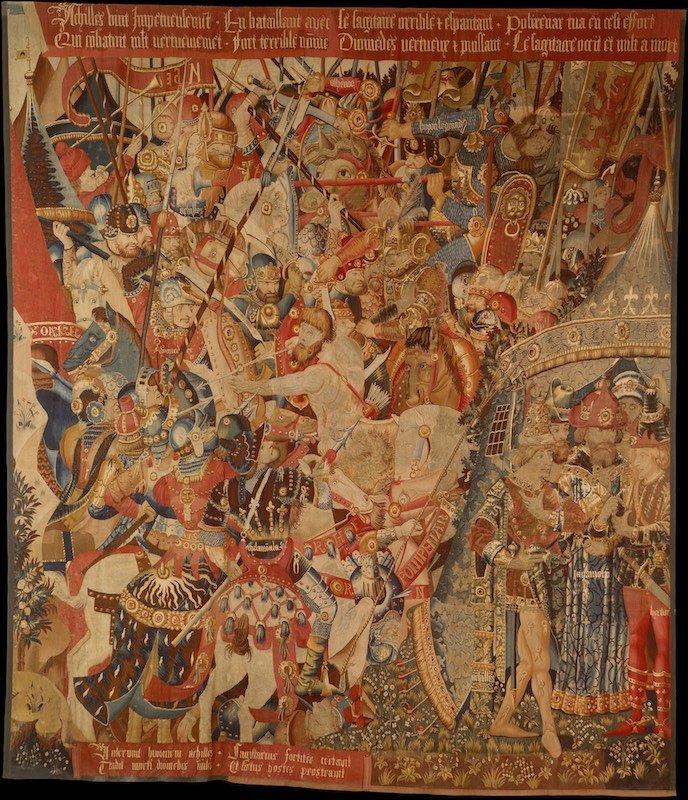
Anyway, I find it helps to think of Spacetime as something more like woven tapestry, especially as we already use the term “fabric” of Spacetime.
The threads (particles) are woven together in a complex pattern, with each one tightly connected to the others around it. What you think of as your body is part of the tapestry. The design of the tapestry is the fabric of spacetime, and the threads can’t just be ripped out and moved elsewhere without unraveling the whole pattern. If you were to take one thread (a particle), it wouldn’t be able to reinsert itself in another part of the tapestry without disrupting the entire structure around it.
The idea of pulling a thread (a particle) from one spot and trying to place it in another part of the tapestry (spacetime) would cause a breakdown of the overall structure.
In science fiction films and TV shows (I’m looking at you, ST:TOS), teleportation is often depicted as a body or object simply popping out from one place and appearing in another. However, this portrayal overlooks the complexities involved in such a process, particularly concerning the removal of the particles present at the destination. Again imagine a tapestry – where are the threads that form the original picture going to suddenly disappear to when you try to jam in the new threads from a separate tapestry?
When an object materialises in a new location, keep in mind that the space isn’t devoid of matter. Even if only air particles are present, along with the area’s quantum wave function, these elements occupy an area of Spacetime. For a new object to appear, it would need to displace billions of existing particles and the underlying wave function.
Where do these displaced particles go?
Are they swapped into the location from which the object disappeared and somehow stitched together into the wave function / fabric?
Or are they moved to another position within the existing universal framework?
Assuming the depiction of time travel in science fiction would also violate conservation of energy and momentum. According to the laws of physics (as we understand them), energy cannot just vanish. When a person or object exists in a given moment in Spacetime, they possess energy — both in terms of their mass energy (thanks to E=mc²) and other forms of energy, such as kinetic or potential energy. If they were to suddenly disappear, the total energy at that point in space would abruptly decrease. If a 70 kg person disappears, that’s an immediate loss of around 6.3 x 10¹⁸ joules of energy (based on E=mc²). The energy that makes up their mass is now gone, which violates the principle that energy in a closed system must remain constant. If they were moving, their kinetic energy would also suddenly vanish. For example, if someone or something moving at 88 mph suddenly disappeared due to time travel, the violations of the conservation of energy and momentum would be even more pronounced. No laws of physics allow for such a massive amount of energy to just disappear from the universe without leaving a trace or causing catastrophic effects.
A DeLorean moving at 88 mph (39.34 m/s), would have enormous momentum. This momentum isn’t just a property of the car; it’s part of the overall momentum of the Earth-car system. If the car suddenly vanishes due to time travel, the Earth’s surface is still moving relative to the car. The car’s momentum disappearing would violate the conservation of momentum, because there’s nothing else to “take on” that momentum.
Not to mention the impact on air displacement and pressure, surface friction and heat (eg the tyres on the road), gravitational influences, etc, or the reverse of those issues in the spot where it arrives.
Now, you might think “Ah, dummy, if the DeLorean reappeared in the same universe it left from, then the total energy of the closed system is still the same!” You can “balance the books”.
But this ignores the time factor of the energy system. If it disappeared from 1985 and reappeared in 1955, that would mean 30 years’ worth of physical interactions (e.g., gravitational forces) that the DeLorean would have had with the environment are effectively erased in that timeframe. Those forces need to be redistributed or compensated for somehow. If it jumps into the future, the missing energy and momentum would create disturbances the entire time it’s gone.
If we consider (as BTTF seems to) the Everett / Many-Worlds Interpretation (MWI), it’s an entirely different and parallel universe that the car is appearing in (and disappearing from), which does violate conservation of energy laws.
The bottom line (admittedly based on my completely amateur knowledge from a lifetime of reading about physics) is this – if someone or something suddenly disappeared due to time travel, you’d have massive violations of both energy and momentum conservation, which physics doesn’t allow, and the fabric of Spacetime would be ripped apart with enormous consequences. The same would be true in the section of the universe where the
Maybe it could be possible with some kind of incredibly advanced alien (Time Lord) technology – but the idea seems far-fetched to take seriously. As far as I can tell, no amount of talk of wormholes or quantum entanglement, etc, aren’t going to resolve these issues, apart from (perhaps) very, very small scales (eg sub-atomic particles).
If people like Altman, Musk, Kurzweil, Hassabis, Huang, etc, are correct, then in the next 5 years (and possibly much sooner) we will start to have AI agents that are smarter than any single qualified human expert in every domain – every branch of science, medicine, comp-sci, etc.
And one of the biggest implications of this, as Altman has been pointing out, is a world where we have a million new experts on every topic, available to analyse and interpret the results of existing experiments, to conceive of and run new virtual experiments and advise humans on how to run physical experiments in the lab, then analyse those results.
And yet, outside of the occasional article in the MSM and forums like reddit, I don’t think see much discussion about this potential reality.
What does the world’s response to climate change look like when we have a million new virtual climate scientists?
What does health care look like when we have a million new virtual doctors and lab technicians?
What does mental health care look like when we have a million new virtual therapists?
What does cold fusion research look like when we have a million new virtual scientists working on that?
What does AI look like when we have a million new virtual AI programmers working on that?
What does a million new experts mean for Nano tech?
For Space travel?
For Robotics?
For Education?
For inequality in capitalism and the future of money?
What happens if AI-jet-powered science quickly helps make K. Eric Drexler’s visions of nanotech come to reality and we have nanofabricators in every house and suburb to make most of our daily food and material needs from waste products, and robots, their components made in nanofabs, to make anything requiring large-scale assembly? What happens to the cost of productions when anyone can make their friend their own nanofab and robot assistant with their own nanofab and robot?
Where are the politicians, journalists and social scientists who are discussing this in the mainstream?
There is a lot of talk about the threat of AI, either by bad actors or it becoming sentient and going all HAL2000.
But what about the age of miracles? How are we preparing for that possible eventuality in the next decade?
One fine day, the leaf became conscious and started to ask questions about itself and the meaning of life. It enjoyed the experience of being alive.
But here’s something you probably didn’t know about leaves – they can only see the colour green. So the leaf couldn’t see the branch it was attached to, or the main trunk of the tree. It thought it was just floating in the air, independent and free.
After a while, the novelty of being a leaf wore off and the leaf, who was on a lower branch of the tree, looked up and saw there were leaves that were higher up in the air, where they got more sunlight and had a better view of the world.
“I want to be where those leaves are”, the leaf thought to itself. It spoke to some other young leaves who told it that if it just wanted it badly enough, and was prepared to work for it, a leaf could move anywhere it wanted to. After all, those leaves somehow got up there, so why not us? We are just as deserving.
So the young leaf decided to work hard to improve its circumstances. It would focus all of its energy on moving higher up in the air. Now, sometimes, when it focused hard, the leaf could feel itself moving and thought it was succeeding. It didn’t understand that the movement was the result of the wind blowing. But other times when it focused hard, the wind didn’t blow, and the leaf was frustrated with its lack of progress. After a while, the leaf got depressed.
“Life’s not fair,” it would think. “I suck at being a leaf. I’m a bad, stupid, unworthy leaf. I don’t believe in myself enough. Nobody will ever love me.”
One day, it got talking to another, older, wiser leaf.
“You seem happy,” said the young leaf to the wise, old leaf. “What is your secret?”
“The secret, young leaf, is to know that you are connected to all other leaves by a tree,” said the wise leaf. “In fact, you ARE the tree.”
“What is this tree you speak of?” Asked the young leaf.
“It’s the invisible framework that connects us all and gives us life” said the wise leaf.
“But how do I get to be one of those higher leaves?” asked the young leaf.
“You are ALL of the leaves,” replied the wise leaf. “You are the entire tree. You are just one node of consciousness in the entire tree of life.”
“I understand that you are probably right in theory,” said the young leaf, “but how does that help me? How can I be happy?”
“Accept that you are the tree and enjoy the experience of also being a leaf,” said the wise leaf. “It won’t last forever.”
“But I can think fro myself,” said the young leaf. “Surely that means I am free to do whatever I choose.”
“Thinking and choosing are just chemical events generated by the tree,” said the wise leaf. “Like photosynthesis. Do you think you are free to photosynthesize?”
“No, but I’m not aware of the photosynthesis,” said the young leaf. “It just happens.”
“Exactly,” said the wise leaf. “You are aware of your thinking, so you think you are in control of it. But it’s really the same process as the photosynthesis. Both are just chemical events happening to the tree. Accept you are the tree, and everything will become clear and life will be simple, free from stress and anxiety.”
But the young leaf couldn’t see the tree, so it refused to accept what the wise leaf said. Leafs, like people, can only hear when they are ready to hear.
“If I accept what you’re saying, I would be miserable,” said the young leaf. “That would mean I’m stuck being a lower leaf. It seems like a defeatist, fatalist philosophy.”
“On the contrary,” replied the wise leaf. “Acceptance of the reality of things is the only path to permanent happiness and peace. Fighting against reality is a certain path to misery.”
But the young leaf was too caught up in its desire to be special, so instead of accepting the truth of the tree, it tried to escape its misery by drinking and binging Netflix, took up obsessively going to the gym, read a lot of books about having a positive mental attitude, eventually becoming angry at itself and bitter at the world, until it finally withered away and died and was replaced with a new leaf.
The tree smiled as the new leaf became conscious and started to ask questions of the other leaves.
We wrap up our antivax mini-series by looking at another antivax claim: “All vaccines contain a number of toxic poisons and chemicals that are linked to serious neurological damage”. We talk about Robert Kennedy Jr, thimerosal, and the difference between methyl vs ethyl mercury.
Great thoughts on dealing with science denialism from this article in Newsweek about flat earthers. I’ve discussed similar ideas in my recent Bullshit Filter series dealing with antivaxers.
A better way to respond is to stop talking about proof, certainty, and logic, and start talking more about scientific “values.” In my book The Scientific Attitude: Defending Science From Denial, Fraud, And Pseudosience, I defend the idea that what is most distinctive about science is not its method but its “attitude”: the idea that scientists care about evidence and are willing to change their views based on new evidence. This is what truly separates scientists from their deniers and imitators.
The problem with conspiracy theorists is that they hold themselves up as skeptics, but they are actually quite gullible. There is a rampant double standard for evidence: no evidence is good enough to convince them of something they do NOT want to believe, yet only the flimsiest evidence is required to get them to accept something they DO want to believe. Contrast this to the “scientific attitude,” which is a mindset of flexibility toward changing one’s beliefs based on new evidence.
Instead of saying “show me your evidence” (which they were only too happy to do) or “here’s my evidence” (which they wouldn’t believe anyway,) I asked “what would it take to convince you that you were wrong?” They seemed unprepared for this question.
For years I’ve used a similar approach with Christians. “What would it take you to stop believing?” They often say “nothing could stop me”. No amount of evidence? “Nothing.” Which demonstrates that they don’t care about facts, evidence or logic. They believe because they want to believe. But I haven’t tried the same approach with other forms of science denialism yet.
“The whole world was seen as the divine activity welling up from the mysterious being of Brahman, which was the inner meaning of all existence. The Upanishads encouraged people to cultivate a sense of Brahman in all things. It was a process of revelation in the literal meaning of the word: it was an unveiling of the hidden ground of all being. Everything that happens became a manifestation of Brahman: true insight lay in the perception of the unity behind the different phenomena.”
‘A History of God: The 4000-Year Quest of Judaism, Christianity, and Islam’ by Karen Armstrong
In other words – Brahman = the laws of physics, atoms, whatever you want to call the underlying fabric of the cosmos.