The Great Socialism Experiment

WHY DID COMMUNISM FAIL?

I’ve spent decades trying to understand what happened to the “Communist” (although they are better describes as “Socialist”) experiments in the twentieth century, including having spent many years producing a podcast about the Cold War. And the answer to the question “why did the Communist countries fail” is, as you might expect, because you’re pretty smart – complicated. Not only complicated, but also it’s the wrong question because not all of them did fail. China, for example, is doing pretty great by most measurements, and still run by the Chinese Communist Party. In discussions about communism, people often forget about China or they go to great lengths to argue that China isn’t really a Communist country today – which is debatable. 

This post is going to be my attempt to lay out the basic framework for understanding what happened to communism – and why it matters today.

TL;DR

The short version of the story is this:

    1. The major advantage Communism, as a socio-economic theory, has over Capitalism, is that a vision for a better world is central to its vision. Communism dreams of a world of peace, harmony and equality. Marx and Engels provided a broad, albeit abstract, vision for a communist society in their works, emphasizing the abolition of class distinctions, the communal ownership of the means of production, and the end of exploitation. Their vision was centred around a society where human potential could flourish once freed from the constraints of class oppression and material deprivation. Capitalism has no central vision for a better world. It simply assumes that things will just all work out in the end. The largest and longest- running Capitalist experiment, The United States of America, demonstrates the flaws in that assumption. The country has enormous socio-economic issues (economic depressions, huge wealth inequality, wars driven by greed, corruption in the political system, racism, violence, an inability to effectively deal with major threats such as climate change or the COVID-19 pandemic, etc) and doesn’t seem to be able to pull itself out of the tailspin of Late Stage Capitalism.
    1. We should think of the early Communist / Socialist countries, as flawed experiments, not as proof whether or not a theory of social co-operation can or cannot succeed. These early experiments had many problems, but so has capitalism over the course of its history. Like all scientific experiments, we should learn from what went wrong and not throw the baby out with the bathwater. Imagine if someone in 1901 said the idea of people flying in aeroplanes was a “vain fantasy”. Oh wait, someone did – The Engineer-in-Chief of the U.S. Navy.

      1. The early experiments in Communism tried (for good reasons) to quantum leap their countries from being largely agrarian and illiterate societies, barely out of Feudalism (USSR, China) and/or Colonialism (Cuba, Vietnam, North Korea), over the Capitalist phase, and straight into a Socialist transitionary phase, which would lead to the Communism phase. This runs counter to the Marxist view of the progression of society, which envisioned Socialism as the phase to emerge out of an advanced Capitalism.

      1. The early experiments in Communism faced early civil wars, plus immediate, significant, and genuine threats of war and/or invasion from the much more economically and militarily developed Capitalist countries, as well as economic sanctions which blocked their attempts at rapid economic development. They were forced to spend enormous amounts of wealth and labour just to defend themselves against external threats. In some cases (USSR, Vietnam, North Korea) they did have to deal with invasions from foreign Capitalist enemies during the early years of their development, which lead to death and destruction of the meagre infrastructure they had to work with in the first place. They had no “Big Brother” they could turn to for economic and military support.

      1. The Capitalist countries did have the advantage of a Big Brother, The United States of America, which, due to geographic good luck, was not directly attacked during WWI or WWII, did not lose millions of its men and women in those wars, did not have its core infrastructure destroyed by bombs, and therefore emerged in the middle of the twentieth century as the global superpower. It was able to use its economic wealth to isolate the developing Socialist countries, both economically and militarily, and bleed them dry over the next seven decades, by bribing and coercing most of the world to join their economic and trading bloc. Capitalism largely succeeded due to geographic luck.

      1. The attempt by the early Socialist countries to use central planning to manage rapid economic development was hampered by the level of technology in the early twentieth century. They did not have the advantage of having the internet, smart phones, and satellites. Today, in the world’s most advanced countries, government and corporations use “centralised planning” every single day to manage their domestic and global affairs. Central planning requires sophisticated technology.

      1. Some of the early Socialist experiments were co-opted by psychopaths. Psychopaths are a problem everywhere – in every country, and in every organisation. They are defined by a strong drive for power and wealth, low levels of empathy, a high appetite for risk, and a superiority complex, which is often reinforced by early successes derived from the first three, which enables them to do things that most “normal” people aren’t willing or able to do. Psychopaths also rise to the top of Capitalist countries, but they are spread widely, as there are more opportunities to take advantage of, across government, business, religion, the military, the police, the legal system, etc. In developing countries, the opportunities for psychopaths to get wealth and power are more limited, so they tend to end up concentrating in government, the military and religion.


    For those of you with an old fashioned attention span, let’s drill down in these ideas in more detail.

    A Vision For Humanity

    The 20th century witnessed unprecedented efforts to reimagine human societies. Socialism and communism—rooted in the revolutionary ideals of Karl Marx and Friedrich Engels—promised to end exploitation, eliminate inequality, and create systems where resources were distributed based on need. Yet, history shows us that most attempts to implement these ideologies on a national scale encountered significant hurdles. These failures have often been used to dismiss socialist ideals entirely, but a closer examination reveals that the issues were far more complex, rooted in historical, economic, and geopolitical realities.

    This post examines the reasons behind the struggles of 20th-century socialism, compares them to capitalism’s own failures, and explores the relevance of these debates in addressing today’s pressing global challenges.

    Trying To Skip Over Capitalism

    The starting point should be to clarify something at the outset. None of the countries that usually come up in these discussions – the USSR, China, Cuba, Vietnam, North Korea, etc – were actually examples of “communism”. Communism was the stated goal of each country. It was an ideal, a vision for the future, a dream to work towards. But in Marxism, communism is the end point of a long journey, not the starting point. Those countries were trying to implement socialism, which is just a stepping stone on the journey to communism, or, as Marx called it, “a political transition period”.

    “Between capitalist and communist society lies the period of the revolutionary transformation of the one into the other. Corresponding to this is also a political transition period in which the state can be nothing but the revolutionary dictatorship of the proletariat.” (Critique of the Gotha Programme)

    Marx and Engels believed that societies would transition from feudalism to capitalism, then through socialism (where the state managed the political transition period) and, finally, into communism (where the state is no longer required).

    It was important for countries to go through capitalism in order to build out the required infrastructure (“material forces of production”) to allow for the socialist transition period. It was also important for the people to be literate so they could read and educate themselves.

    “No social order is ever destroyed before all the productive forces for which it is sufficient have been developed, and new, higher relations of production never appear before the material conditions of their existence have matured in the womb of the old society.” (Preface to A Contribution to the Critique of Political Economy)

    However, socialist revolutions in the 20th century often occurred in nations far removed from the advanced industrial economies Marx and Engels had envisioned. Russia, China, Vietnam, and Cuba—all significant examples of socialist experiments—were primarily agrarian societies before their revolutions. In these contexts, the necessary economic foundations for socialism were missing. Marx’s framework assumed that capitalism would first fully develop the forces of production, creating a strong industrial base and a politically active proletariat. Yet, in these countries, revolutions were often led by rural peasants rather than urban workers, and the economies were anything but industrialized.

    For instance:

    Russia in 1917 was a nation devastated by World War I, with an economy heavily reliant on agriculture. The Bolsheviks inherited a country with little infrastructure to support industrial development.

    China in 1949 faced similar challenges, having endured decades of civil war, Japanese occupation, and economic stagnation.

    Vietnam and Cuba were even less industrialized, transitioning directly from colonial or semi-feudal systems to socialism.

    Skipping the capitalist phase meant that these revolutions had to industrialise from scratch, a monumental task compounded by political and military pressures.

    It’s important to point out that they didn’t just try to skip the capitalism phase just because they were in a hurry to modernise. There was a worldwide inherent distrust of capitalism in the early decades of the twentieth century, especially after the two world wars, which were seen by many to be the result of capitalist greed, and the Great Depression. The countries who tried to implement socialism had also had direct confrontations with capitalist countries who tried to exert control over each of them. The United States and the United Kingdom both invaded Russia shortly after the Russian Revolution in support of the Czars. The United Kingdom had forced its will on China during the Opium Wars and the United States sided with the Kuomintang during the Chinese civil war. The United States supported France’s colonial occupation of Vietnam during the First Indochina War. And the United States supplied Cuba with planes, ships, tanks, and other technology such as napalm, which was used against the rebels during the Cuban Revolution.

    Centralised Planning Before Computers

    In an attempt to move an entire country quickly forwards – to be ready for invasions by, or war with, the capitalist countries, and famines – these early socialist experiments attempted to use central planning to quickly modernise their countries and to manage the activities of hundreds of millions of people – decades before computers, the Internet and satellites. The population of the Soviet Union in 1920 was estimated to be about 135 million people living in over 22,402,200 square kilometres (8,649,500 square miles). In 1950, China had a population of 552.0 million people in approximately 9.6 million square kilometers of land.

    While they aimed to drive rapid modernisation, their attempts often led to inefficiencies and terrible tragedies. Central planners lacked the real-time information that would have been required to manage such a large effort, leading to misallocation of resources. Factories produced goods that no one wanted, while basic necessities like food and clothing were often in short supply.

    For example:

    • The Soviet Union’s Five-Year Plans achieved rapid industrialisation but often at great human and environmental costs. Quotas were met on paper but ignored quality and usability.

    Mao’s Great Leap Forward in China attempted to transform the country’s agrarian economy overnight, leading to one of the worst famines in human history.

    These inefficiencies were not inevitable but rather a result of the technological limitations of the time. Today, corporations and governments use modern technology to centrally plan their affairs every day. It isn’t that centralised planning is inherently a faulty concept, it was just impossible at the time.

    Socialism Does Not Equal Political Repression

    Many socialist regimes became authoritarian, concentrating power in the hands of a single party or leader. This centralization often led to political repression, surveillance states, and the erosion of individual freedoms. However authoritarianism is not inherent to socialism. There is nothing in the writings of Marx or Engel that suggest authoritarianism is required. On the contrary, they argue for the “dictatorship of the proletariat”, which they as a temporary phase of working-class rule, fundamentally democratic in nature, aimed at dismantling class distinctions and transitioning toward a classless, stateless society.

    Unfortunately, every society has psychopaths. Experts suggest that between one and four percent of the population at any given time might score highly on the psychopath test. In every country, psychopaths gravitate towards opportunities for power. In the past they have become kings, dukes, popes, and prophets. In modern times, they often become corporate executives, politicians, military leaders, police chiefs… and kings, popes and prophets. We have not yet figured out how to prevent them from getting their hands on power in capitalist countries, and socialist countries weren’t any better.

    However, because these socialist countries were less developed economically, there were fewer places for the psychopaths to find power, so most of them gravitated towards politics and the military. As the countries were all re-building after the destruction from long periods of civil and international war, these countries also had very few institutions that could protect them from having psychopaths rise to power.

    In addition, these countries were constantly on a war footing from day one, with endless threats and attacks from external enemies and their attempts at overthrowing the socialist governments through spies and agents. This lead to the socialist states having to enact harsh measures to prevent destabilisation of their new governments. It’s worth pointing out that capitalist countries also enacted harsh measures against external threats during times of war, for example, McCarthyism in both the U.S.A.and the U.K., the Japanese internment camps in the U.S.A., etc, but these weren’t newly-established governments of extremely poor and developing countries, so their reactions weren’t as harsh.

    The Economic Cost of The Cold War

    Socialist countries faced intense external pressures, particularly during the Cold War. The United States and its allies sought to destroy socialism, employing economic sanctions, propaganda, and even military interventions. For example:

    • The Soviet Union was forced into an arms race that drained resources from domestic needs.

    Cuba continues to endure decades of economic embargoes that crippled its economy.

    Vietnam faced catastrophic invasion and bombing campaigns during the war with the United States.

    North Korea also faced an American invasion.

    These external pressures exacerbated internal economic challenges, making it nearly impossible for socialist economies to thrive. Unlike Western Europe, which benefited from American aid through the Marshall Plan, socialist nations received little support and were often isolated. Their ability to trade with the more developed countries was hampered, and their ability to invest in domestic infrastructure was limited by the need to maintain an arms race against a far more wealthy enemy.

    Capitalism’s Failures: The Other Side of the Coin

    While socialism’s struggles are often highlighted, capitalism is far from a flawless system.

    A quick survey of capitalism’s first century demonstrates that it took a long time to stabilise and find its way.

    In early capitalist societies, child labour became a cornerstone of industrial economies. The factory system, with its insatiable demand for cheap labour, capitalised on the vulnerability of children from poor families. Children worked in textile mills, coal mines, and other industries under hazardous conditions. In mines, children as young as five crawled through narrow tunnels hauling heavy loads of coal. Workdays often lasted 12-16 hours, six days a week, leaving children physically exhausted and deprived of education. Poor ventilation, exposure to dangerous machinery, and lack of safety measures caused frequent injuries and illnesses.

    Slavery played a crucial role in the early development of capitalism, particularly in the Americas and Europe, as a source of cheap labor for plantation economies and industries. In fact, a large part of the financial strength of the capitalist West by the time of the Cold War can be attributed to its history of slavery.

    Financial institutions like the Bank of England and insurance companies profited from underwriting slave ships and plantations. In the United States, slavery was integral to the Southern economy and a key driver of global trade. The cotton industry, powered by enslaved labor, supplied raw materials to British textile mills, fueling industrial growth.

    The rapid urbanization driven by industrial capitalism created overcrowded cities with dire living conditions for the working class. Workers lived in cramped, poorly ventilated tenements often located near factories, exposing them to pollution. Lack of sewage systems led to outbreaks of diseases like cholera and typhoid. While industrialists and factory owners amassed wealth, workers faced subsistence wages and squalid living conditions.

    The expansion of capitalism was deeply tied to imperialism, as European powers sought raw materials, markets, and cheap labor in colonized regions. Colonies supplied raw materials like cotton, rubber, and minerals, which were processed in European factories and sold back to colonial markets at inflated prices. Local economies were often destroyed as subsistence agriculture gave way to cash crops, leading to food insecurity. Indigenous populations were displaced, enslaved, or massacred. The Belgian Congo under King Leopold II is a harrowing example, with millions killed or mutilated in the pursuit of rubber and ivory profits.

    Early capitalism operated without labor regulations, subjecting workers to inhumane conditions. Factory owners maximized profits by keeping wages low and demanding long hours from workers. Workers had no legal protections, no sick leave, and no recourse against abusive employers. These abuses spurred the growth of labor unions and socialist movements, which fought for better wages, reasonable working hours, and safer conditions. Strikes and protests were often met with violent crackdowns by state and private forces, highlighting the alignment of early capitalist states with business interests.

    The rise of industrial capitalism brought about significant environmental destruction. Factories discharged pollutants into rivers and the air, turning urban centers into smog-filled, disease-ridden environments. The destruction of forests for agriculture and industry caused widespread ecological harm. The unregulated extraction of coal, iron, and other resources fueled industrial growth but left landscapes devastated.

    And of course we could talk about The Great Depression of the 1930s, the 2008 financial crisis, the rise of Donald Trump and the billionaire class of politicians and other far-right parties around the world, endless wars fought to grow and maintain American hegemony, the inability to deal with climate change, and growing income inequality demonstrate that capitalism has its own systemic issues.

    However western commentators don’t look at all of these historical issues and say “capitalism failed”. We just accept that capitalism has problems and hope that somehow, some day, someone will fix them. In the meantime, they just seem to grow. And this is partly because there isn’t a coherent vision for the end point of capitalism. There’s no utopian vision that everyone in capitalist countries is striving towards. There is no better tomorrow. Communism, for all of its struggles in the last century, at least has an articulated vision for a better tomorrow.


    China’s Hybrid Model: A Unique Case Study

    China’s economic success offers an alternative narrative. After Mao’s death, Deng Xiaoping was able to restructure the Chinese socialist experiment. He had long realised that the CCP leadership had failed the people by trying to do too much, too quickly and with the wrong mechanisms. As he once said:

    “These were not just Mao’s mistakes, they were all our mistakes. Many of us made mistakes; we lacked experience and had poor judgment.”

    “Deng Xiaoping and the Transformation of China”, Ezra F. Vogel

    He introduced market reforms while retaining state control over key sectors. This hybrid model lifted hundreds of millions out of poverty and transformed China into a global superpower. While many people in the West seem to believe that China is no longer socialist, the CCP itself refers to its current economic model as “Socialism with Chinese Characteristics”.

    “Only by upholding socialism with Chinese characteristics can we bring together and lead the whole Party, the whole nation and the people of all ethnic groups in realizing a moderately prosperous society by the centenary of the CPC in 2021 and in turning China into a prosperous, democratic, culturally advanced and harmonious modern socialist country by the centenary of the People’s Republic of China in 2049, so as to ensure the people greater happiness and the nation a brighter future.”

    Xi Jinping: The Governance of China

    China’s success in the last 50 years demonstrates that socialism didn’t “fail” as many people in the West seem to think. The Chinese socialist experiment took a while to find its way – and is still developing – as is true of capitalism.

    A Scientific Perspective: Socialism as Experimentation

    Drawing a parallel to scientific discovery, socialist experiments can be seen as part of an iterative process. Early failures in aviation did not discredit the concept of human flight; rather, they provided crucial lessons that led to eventual success. Similarly, the failures of 20th-century socialism could inform future attempts to create equitable systems.

    Advocates argue that modern technology, combined with democratic frameworks, could address many of the issues that plagued earlier socialist experiments. Ideas like universal basic income, participatory budgeting, and worker cooperatives represent modern adaptations of socialist principles.

    Conclusion: Rethinking the Debate

    The debate between socialism and capitalism is not merely historical but deeply relevant to today’s global challenges. As the world grapples with inequality, climate change, and political instability, reimagining economic systems is more critical than ever. While 20th-century socialism struggled under the weight of its contradictions and context, its ideals continue to inspire movements seeking a more just and sustainable future.

    Modern technologies, from smartphones to satellites and machine intelligence, allow us to plan and manage a better society in ways the twentieth century socialists could only dream of. The same technologies can also be applied to make it difficult for psychopaths to derail the transition to communism.

    Rather than dismissing socialism outright, we should view its history as a source of lessons for building better systems in the 21st century.


     

    2024-12-01

    Mungable Politics

    It’s amusing to me how mungable the political spectrum is in the United States.

    On one hand, you’ve got Republicans passionate about Trump appointing Elon and Vivek to remove government regulations with the DOGE. Because government regulations are bad, mmkay?

    Meanwhile, they are also excited about RFK jr’s plans as the incoming Health Secretary “for greater regulation of food additives and ultraprocessed foods”.

    Regulation over here = bad. Regulation over there = good.

    It just goes to show you that Trump doesn’t really have a position on regulation. It’s a tool that should be used or prevented on a basis to be determined by “what sells”.

    And just to show it isn’t only the Republicans who have mungable positions – the Democrats in the U.S.A. have been wanting more regulations on food additives for years but doing little about it when they had the chance. Now they are up in arms over the appointment of RFK jr. And while I agree that many of his positions are bonkers, and even a broken clock is right twice a day, you should at least be able to agree with people from the other side when they say something that makes sense.

    Like, for example, Trump saying the U.S.A. should stop supporting Ukraine. I’ve talked about this for years on the Bullshit Filter, but you should also listen to these recent interviews with Scott Horton on Greenwald and Jeffrey Sachs on Useful Idiots who explain the background in lots of detail.

    People keep asking me whether or not I think Trump is really anti-war. I don’t think he has a firm position on that, either. I think he’ll do whatever suits his private interests or the interests of his biggest supporters. He’ll probably lower U.S. support for their sneaky takeover of Ukraine but increase support for Israel’s genocide, and at some point attack Iran again.

    Like his position on TikTok (wanting to ban it during his first term, then wanted to support it when one of their biggest investors became one of his biggest supporters), everything is mungable. Trump‘s strategy seems to be “let’s go find out what people are angry about or passionate about and then just say we’re going to fix that”, and in doing so, he’s managed to take over the Republican Party and turn it into a new party which has managed to grab the working class vote as well as various progressive positions like bigger regulations on health and food and ending the war in Ukraine. It’s really incredible to watch play out.

    Elon and his Messiah Complex

    My boys and I were talking this morning over chess about Elon and his messiah complex. We’re convinced that he thinks it is justified to do whatever he has to do (including help get Trump elected) in order to move fast enough with his plans to save the human race from extinction. In philosophy it’s called “consequentialism”. I talked about the idea of ‘consequentialism’ in The Psychopath Epidemic:

    Soviet leader Josef Stalin’s “Great Purge” and his collectivization of the Soviet agricultural sector might be examples of consequentialism. His desire to force the Soviet Union into a more productive economy and to rid her of internal counter-revolutionaries (real or imagined) may have, in his mind, justified breaking a few—or a million—eggs. He might have concluded that it was better that a million people should go to the gulags than have two hundred million people starve or murdered during the next invasion. As it turned out, when the Germans invaded the Soviet Union a few years later, only twenty-seven million Soviet people died, thanks partly to Stalin’s push for rapid industrialization in the previous few years.

    The dropping of atomic bombs on Japan during World War II, resulting in the death of hundreds of thousands of civilians, is often rationalized by people in the United States as being necessary to prevent a land invasion of Japan, which would have potentially led to even more deaths. Earlier in WWII, the RAF and USAF dropped hundreds of thousands of phosphorus bombs on civilian centers in Germany —650,000 on Dresden alone. Tens of thousands of innocent people died, mostly women and children noncombatants, “simply for the sake of increasing the terror,” according to British Prime Minister Winston Churchill. Of course, this was justified as a means of helping the Allies win the war.

    From 1990 until 2003, the United Nations imposed debilitating economic sanctions on Iraq, resulting in the deaths of between 500,000 and 1 million people (depending on which source you believe)—half of them children. Denis Halliday, the appointed United Nations Humanitarian Coordinator in Baghdad, resigned in 1998 after a thirty-four-year career with the UN, saying, “I don’t want to administer a program that satisfies the definition of genocide.” Halliday’s successor also resigned in protest, calling the effects of the sanctions a “true human tragedy.” The stated aim of the sanctions was to eliminate Iraq’s weapons of mass destruction. When asked by Lesley Stahl of CBS News if the price of 500,000 dead children was worth it, former U.S. Secretary of State Madeleine Albright, who at the time was Bill Clinton’s UN Ambassador, replied, “I think this is a very hard choice, but the price—we think the price is worth it.” Although the total number of dead children is now debated, Albright’s response, to a number she apparently accepted at the time, is the point.

    For Elon it might just be The Trolley Problem on a global scale. He might think it’s worth whatever it takes to save humanity and that he can only do that under a Trump administration that he can manipulate. Of course, I think he probably also thinks of Trump as a mental (and financial) dwarf. Musk is definitely the smarter, as well as the richer, of the two. And, arguably, the more powerful.

    NATO v Russia

    The Biden administration’s recent decision to allow Ukraine / NATO to fire missiles deep into Russian territory demonstrates the lies that the West have been claiming about NATO’s bases that surround Russia for the last couple of years. “Oh they are just defensive” they say. Until they aren’t, of course. So now we see Ukraine firing ATACMS into Russia, which can only be done with the direct involvement of NATO / USA.

    According to the NYT:

    The long-range missile — known as ATACMS and pronounced like “attack ’ems” — can strike targets 190 miles away with a warhead containing about 375 pounds of explosives. It can be fired from the HIMARS mobile launchers that the United States has provided Ukraine, as well as from older M270 launchers sent from Britain and Germany.

    Apparently Biden is no longer trying to prevent World War III. I’ve heard it explain, by people like Jeffrey Sachs, that the Biden administration figure Putin figures that Trump will put an end to it in a month, so there’s no point launching nukes. Meanwhile, the hawks in the Pentagon and Biden administration get to have some fun blowing shit up.

    By the way, as I heard someone say recently, can you imagine how Russians feel about German tanks being in Ukraine after the history Russia had in the 20th century with German invasions? Especially when part of the agreement about NATO not expanding if Russia allowed a re-united Germany was the fear of exactly that?


    And the whole argument that NATO bases are “for defense” would ring a little hollow to Russian ears. Apart from the fact that it isn’t true, as they can obviously easily be used for firing missiles into Russia (as per Ukraine), they could also be used to prevent a retaliation from Russia in the event of a first strike from the West.

    #1 – It Was 20 Years Ago Today

    #1 – It Was 20 Years Ago Today

    Twenty years ago today, way back in November 2004, I recorded my first podcast. It was the very early days of podcasting, which really kicked off in August 2004. I, along with my co-host Mick Stanic, recorded the first Australian podcast – “G’Day World“. I was recently notified that some of the early episodes have been added to the National Film and Sound Archive of Australia, “to represent the development and experience of podcasting in Australia, and to ensure that podcasts are available for future generations to listen to and research.” It’s also up on archive.org. One of our earliest G’Day World guests, who then became one of our launch hosts on The Podcast Network in February 2005, was BAFTA nominated broadcaster Ewan Spence. He and I caught up recently to talk about the early days of podcasting and how it’s changed our lives.  
    2024-11-18

    2024-11-18

    “At the moment that the “normal” police and military resources of the bourgeois dictatorship, together with their parliamentary screens, no longer suffice to hold society in a state of equilibrium — the turn of the fascist regime arrives. Through the fascist agency, capitalism sets in motion the masses of the crazed petty bourgeoisie and the bands of declassed and demoralized lumpenproletariat — all the countless human beings whom finance capital itself has brought to desperation and frenzy.”

    Excerpt from
    Fascism: What it is and how to fight it (1944)
    Trotsky, Leon

    I’ve been thinking about “all the countless human beings whom finance capital itself has brought to desperation and frenzy” and my mind went back to the Occupy Wall Street movement of 2011. Obama’s America.

    What did Trump have to say about that at the time?

    From the Daily News, 13 December 2011:

    Trump on Occupy Wall StreetTrump on Occupy Wall Street 14 Dec 2011, Wed Daily News (New York, New York) Newspapers.com

    And what did Mr Hope and Change Obama have to say about them? He said some words. But he tried to play both sides.

    “I understand the frustrations that are being expressed in those protests,” Obama said in an interview with ABC News on Tuesday. “The most important thing we can do right now,” he added, is “letting people know that … we are on their side.” When he first expressed sympathy for the Occupy Wall Street movement two weeks ago, Obama added a characteristically cautious qualification: “We have to have a strong, effective financial sector in order for us to grow.”

    Obama Occupy Wall StreetObama Occupy Wall Street 20 Oct 2011, Thu The Los Angeles Times (Los Angeles, California) Newspapers.com

    When the Occupy Wall Street movement was forcibly dismantled by police in late 2011 and into 2012, Obama did not directly intervene to stop the crackdowns. Cities across the country saw coordinated efforts to remove protesters from public spaces, often using riot gear, tear gas, and mass arrests. The Obama administration did nothing. He also did nothing to stop the Supreme Court’s decision on Citizen United, which allowed for unlimited corporate spending in U.S. elections, from becoming law a year earlier.

    Of course, I’m hardly the first person to connect the dots between Occupy Wall Street, the Tea Party, and MAGA. People have been doing it since at least early 2016:

    There was a hunger for someone to provide a message like what Trump is offering—that the cozy Wall Street-Washington nexus cares nothing about them and it is time to take matters into their own hands and reject the blandishments of those who have put them in the state they are in. It was Trump’s genius to be able to understand and articulate that message, and to articulate a message that obliterates the traditional liberal-conservative ideological cleavages.

    But I wonder how many young people today know much about Citizens United, the Tea Party and Occupy Wall Street. I haven’t seen much analysis in the media connecting those dots to Trump’s recent victory. A quick search of the New York Times for “trump occupy Wall Street” in the last year comes up exactly nothing relevant. Nothing much comes up for “trump citizens united”, either. It’s like they don’t want to state the obvious – that the combination of unlimited corporate campaign funding and an angry, disenfranchised and ignored working class came together in the Obama years to create Trump’s second term.

    2024-11-15

    I don’t think people in the United States are taking the warnings about Trump’s inherent fascist tendencies seriously enough. Why would you hand over power to someone you believe is a fascist? Democracy? They don’t have a democracy over there. They have a plutocracy. And that was true even before Elon Musk bought Trump the election.

    Noam Chomsky, institute professor emeritus at the Massachusetts Institute of Technology, author, political activist, and considered the world’s leading intellectual, stated in a 2013 interview that the United States is “no longer a functioning democracy, we’re really a plutocracy.” And that was several years before Trump won the White House!

    I’m reading Michael Mann’s book “Fascists“. That’s Michael Mann the sociologist, not the director of HEAT. One of the defining characteristics of fascism in the twentieth century was their use of a paramilitary.

    Since fascists did offer plausible solutions to modern social problems, they got mass electoral support and intense emotional commitment from militants. Of course, like most political activists, fascists were diverse and opportunistic.

    Michael Mann – Fascists

    So I’m keeping an eye on news stories about American militias, like the Proud Boys and the Oath Keepers. Earlier this year, they seemed to be recruiting again, according to WIRED.


    I’m amused that people who support Trump seem to be convinced that everyone who criticises him suffer from “Trump Derangement Syndrome“, when I think they are the ones who are obviously delusional (if not deranged). His supporters claim that people from his first administration that have since tried to warn everyone about his fascist tendencies have an axe to grind.

    What axe did Mark Milley, the former Chair of the Joint Chiefs of Staff, have, apart from being disgusted with Trump? 

    After federal officers and police had used tear gas and other riot control tactics to disperse protestors, during the protests in Washington, D.C., following the murder of George Floyd, saying that he felt “sick” and was “fucking done with this shit” to Esper. Then after Jan 6, he became concerned Trump was preparing to stage a coup, said “this is a Reichstag moment”, and told his associates “They may try, but they’re not going to fucking succeed. You can’t do this without the military. You can’t do this without the CIA and the FBI. We’re the guys with the guns”, referring to Trump’s false statements about electoral fraud as “the gospel of the Führer”. Milley called Trump a “fascist to the core”.

    Mark Milley, WiKIPEDIA

    John Kelly, former Chief of Staff, called Trump a “fascist” and criticized his authoritarian tendencies.

    James Mattis, former Secretary of Defense, said Trump makes a “mockery of our constitution”.

    John Bolton, former National Security Adviser, labeled Trump “unfit to be president”.

    Some quotes from Bob Woodward, “Fear – Trump in the White House”:

    Gary Cohn, the former president of Goldman Sachs and the president’s top economic adviser in the White House. Cohn and Porter worked together to derail what they believed were Trump’s most impulsive and dangerous orders. “It’s not what we did for the country, ” Cohn said privately. “It’s what we saved him from doing.”

    The reality was that the United States in 2017 was tethered to the words and actions of an emotionally overwrought, mercurial and unpredictable leader. Members of his staff had joined to purposefully block some of what they believed were the president’s most dangerous impulses. It was a nervous breakdown of the executive power of the most powerful country in the world.

    A senior White House official who spoke contemporaneously with participants in the meeting recorded this summary: “The president proceeded to lecture and insult the entire group about how they didn’t know anything when it came to defense or national security. It seems clear that many of the president’s senior advisers, especially those in the national security realm, are extremely concerned with his erratic nature, his relative ignorance, his inability to learn, as well as what they consider his dangerous views.”

    As Staff Secretary, Rob Porter briefed Trump on decision memos and other important presidential documents. In alliance with Gary Cohn, he attempted to block Trump’ s most dangerous economic and foreign policy impulses. Porter told an associate, “A third of my job was trying to react to some of the really dangerous ideas that he had and try to give him reasons to believe that maybe they weren’t such good ideas.”

    Let’s not forget the Trump / Epstein relationship: 

    Jeffrey Epstein, the American financier who was friends with Donald Trump, Bill Clinton, and Prince Andrew, committed suicide in prison under mysterious circumstances. Until 2019, he had managed to avoid much time in jail despite multiple charges of sex trafficking of underage girls going back to 2005 and even a guilty plea in 2008. U.S. attorney Alexander Acosta approved a lenient plea deal for Epstein regarding a case involving prostitution with a fourteen-year-old girl. A decade later, when Acosta was interviewing with Donald Trump’s transition team, he allegedly said he had been told to “back off” Epstein because he “belonged to intelligence.” Acosta went on to become Trump’s Labor Secretary — but resigned when the story about his 2008 deal with Epstein became public.

    The Psychopath Epidemic“, Cameron Reilly (2020)


    CODING ADVENTURES

    I impressed myself this week by writing a couple of Python scripts that will create custom news reports for me every day. I used Claude to write them. They will take a list of stocks, either from the weekly buy list that I generate for QAV, or from my portfolios, create RSS feeds for them in Google News Alerts, then download the news items in those feeds. Once it’s downloaded the latest news, it parses it through OpenAI’s API, which removes duplicate stories from different news outlets, then prioritises the news articles based on a list of criteria I’ve given it, ranking the stories from 10/10 (very high importance) to 1/10 (very low importance), then give me a report which I can post to QAV. Here’s an example from today. I wrote this because I’d missed a couple of important events for stocks in my portfolios in recent weeks. I hold over 100 stocks and it’s hard to trawl through all of the news every day.

    The key here is that it took me a while to even conceive of the idea of writing a script to do all this for me. The “roll your own” mentality isn’t fully installed in my head yet. But I think within a few years we’ll all get used to having AI just build custom “apps” for us, although we probably won’t even think of them as apps, just “functions”. “Do this for me”. That’ll happen when AI Agents are integrated with our devices and our personal information.

    Why Time Travel Is (Probably) Impossible

    As a lifelong fan of Doctor Who and BTTF, it pains me to have to be the one to point out to people that time travel is probably impossible. It particularly bugs me when I hear scientists talking about it like it’s even remotely possible.

    And here’s why.

    Most people tend to think of particles (like the ones that make up our bodies) as things that stand alone, like a billiard ball on a table. But that’s not what physics says particles are.

    Particles don’t exist in a vacuum. They exist as quantum wave functions in Hilbert space / Spacetime (or perhaps, as Sean Carroll suggests, there’s just a single quantum wave function that makes up the entire universe).

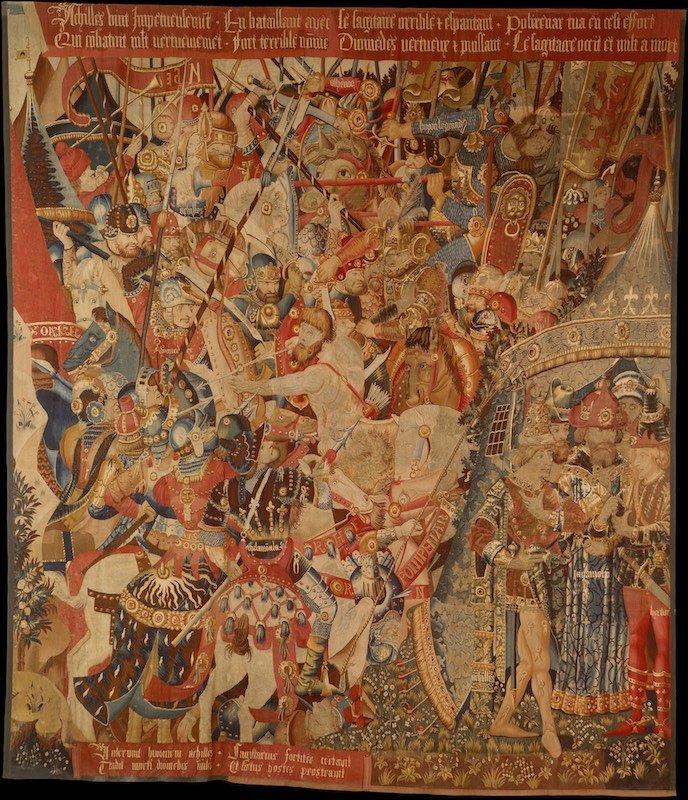
    Anyway, I find it helps to think of Spacetime as something more like woven tapestry, especially as we already use the term “fabric” of Spacetime.

    Imagine each particle as a thread in an intricate tapestry from the Middle Ages (maybe like this one, “The Battle with the Sagittary and the Conference at Achilles’ Tent (from Scenes from the Story of the Trojan War)“).

    The threads (particles) are woven together in a complex pattern, with each one tightly connected to the others around it. What you think of as your body is part of the tapestry. The design of the tapestry is the fabric of spacetime, and the threads can’t just be ripped out and moved elsewhere without unraveling the whole pattern. If you were to take one thread (a particle), it wouldn’t be able to reinsert itself in another part of the tapestry without disrupting the entire structure around it.

    The idea of pulling a thread (a particle) from one spot and trying to place it in another part of the tapestry (spacetime) would cause a breakdown of the overall structure.

    In science fiction films and TV shows (I’m looking at you, ST:TOS), teleportation is often depicted as a body or object simply popping out from one place and appearing in another. However, this portrayal overlooks the complexities involved in such a process, particularly concerning the removal of the particles present at the destination. Again imagine a tapestry – where are the threads that form the original picture going to suddenly disappear to when you try to jam in the new threads from a separate tapestry?

    When an object materialises in a new location, keep in mind that the space isn’t devoid of matter. Even if only air particles are present, along with the area’s quantum wave function, these elements occupy an area of Spacetime. For a new object to appear, it would need to displace billions of existing particles and the underlying wave function.

    • Where do these displaced particles go?
    • Are they swapped into the location from which the object disappeared and somehow stitched together into the wave function / fabric?
    • Or are they moved to another position within the existing universal framework?

    Assuming the depiction of time travel in science fiction would also violate conservation of energy and momentum. According to the laws of physics (as we understand them), energy cannot just vanish. When a person or object exists in a given moment in Spacetime, they possess energy — both in terms of their mass energy (thanks to E=mc²) and other forms of energy, such as kinetic or potential energy. If they were to suddenly disappear, the total energy at that point in space would abruptly decrease.  If a 70 kg person disappears, that’s an immediate loss of around 6.3 x 10¹⁸ joules of energy (based on E=mc²). The energy that makes up their mass is now gone, which violates the principle that energy in a closed system must remain constant. If they were moving, their kinetic energy would also suddenly vanish. For example, if someone or something moving at 88 mph suddenly disappeared due to time travel, the violations of the conservation of energy and momentum would be even more pronounced. No laws of physics allow for such a massive amount of energy to just disappear from the universe without leaving a trace or causing catastrophic effects.

    A DeLorean moving at 88 mph (39.34 m/s), would have enormous momentum. This momentum isn’t just a property of the car; it’s part of the overall momentum of the Earth-car system. If the car suddenly vanishes due to time travel, the Earth’s surface is still moving relative to the car. The car’s momentum disappearing would violate the conservation of momentum, because there’s nothing else to “take on” that momentum.

    Not to mention the impact on air displacement and pressure, surface friction and heat (eg the tyres on the road), gravitational influences, etc, or the reverse of those issues in the spot where it arrives.

    Now, you might think “Ah, dummy, if the DeLorean reappeared in the same universe it left from, then the total energy of the closed system is still the same!” You can “balance the books”.

    But this ignores the time factor of the energy system. If it disappeared from 1985 and reappeared in 1955, that would mean 30 years’ worth of physical interactions (e.g., gravitational forces) that the DeLorean would have had with the environment are effectively erased in that timeframe. Those forces need to be redistributed or compensated for somehow. If it jumps into the future, the missing energy and momentum would create disturbances the entire time it’s gone.

    If we consider (as BTTF seems to) the Everett / Many-Worlds Interpretation (MWI), it’s an entirely different and parallel universe that the car is appearing in (and disappearing from), which does violate conservation of energy laws.

    The bottom line (admittedly based on my completely amateur knowledge from a lifetime of reading about physics) is this – if someone or something suddenly disappeared due to time travel, you’d have massive violations of both energy and momentum conservation, which physics doesn’t allow, and the fabric of Spacetime would be ripped apart with enormous consequences. The same would be true in the section of the universe where the

    Maybe it could be possible with some kind of incredibly advanced alien (Time Lord) technology – but the idea seems far-fetched to take seriously. As far as I can tell, no amount of talk of wormholes or quantum entanglement, etc, aren’t going to resolve these issues, apart from (perhaps) very, very small scales (eg sub-atomic particles).

    Of course, the block theory of the universe also says everything that will happen in the future, has already happened.

    My Version of the Hsin Hsin Ming

    I’ve been a fan of the Hsin Hsin Ming (aka Xin Xin Ming), “Verses on the Faith Mind
” by Seng-ts’an, the 
Third Zen Patriarch [d. 606 CE]
, since Sailor Bob first introduced me to it 35 years ago. There are several translations of it into English, but I don’t think any of them completely do it justice. So here’s my version.

    Finding permanent peace of mind is not difficult for those who do not discriminate.

    When discrimination between what you like and do not like is absent, life becomes simple and straightforward.

    Make the smallest discrimination, however, and life becomes difficult and complicated.

    If you wish to have peace of mind, simple hold no opinions for or against anything.

    To set up what you like against what you dislike, is the disease of the mind.

    If you don’t understand how the universe works, then your mind’s essential peace is disturbed and you will have no peace.

    The universe is perfect. Nothing is lacking and nothing is in excess. It is exactly how it has to be in every single moment – all of the atoms are always obeying the laws of nature.

    However, when we discriminate between what we like and what we don’t like, we are rejecting the true nature of things and this causes us distress.

    Learn to live in peace and harmony with the state of the universe as it is in the moment and you will be serene and the discrimination will stop by itself.

    Don’t dwell either on material things nor on feeling of emptiness. Just accept things as they are.

    Don’t fall into the trap of trying not to do anything. Trying to do nothing is actually doing something. Just do what comes naturally. Remaining in one extreme or another will never bring you peace.

    Don’t fall into the trap of thinking nothing really exists. To deny the reality of things is to miss their reality. Everything really exists even though it may not exist in the way it appears to our senses. The universe exists. And you are it.

    The more you talk and think about it, the further you are from just abiding in the reality of the present moment. Just accept everything about the reality of the present moment and be in it completely. Completely surrender yourself to the present moment without thinking about it. Just BE the present moment.

    At the moment of enlightenment, all thoughts of emptiness and appearances disappear into the recognition that there is only THIS – the complete universe.

    The changes that appear to occur in the world are due to our ignorance about the nature of reality.

    Do not search for enlightenment, only stop discriminating between this and that. Even the slightest discrimination will confuse your mind. Practice extreme acceptance of everything that is happening in the here and now.

    When the mind stops discriminating, nothing can bother you. Everything is just accepted as it is. And when we stop discriminating, the mind becomes quiet and stops thinking of itself as the doer. It realises that things are just happening according to the laws of nature.

    We think there are objects that are separate from us because we think of ourselves as the doer / subject. When the mind becomes quiet, we realise there are no objects because we are no longer the doer / subject. There is a unity of subject and object. We realise that we are just part of the happening of the universe obeying natural laws. The conceptual separation between me and the world vanishes.

    To live with enlightenment is neither difficult nor easy. It is effortless. But people who have not stopped discriminating are fearful of letting go of the ego.

    Don’t even discriminate when it comes to wanted enlightenment. Let things happen in their own way and in their own time. If you cling even to the desire for enlightenment, your mind will not find peace.

    Obey the nature of things and life will be effortless. When we discriminate, life is endlessly tiring and difficult because things are never the way we think they should be for very long. Accept things completely as they are.

    Don’t even dislike the world of the senses and ideas. Accept them fully as you accept everything else. This is enlightenment.

    The wise person realises the universe obeys its own laws. It doesn’t care about your goals and dreams or what you think is fair and just. Be at peace with what you have and where you are. Goals and dreams are illusions. Gain and loss, right and wrong – abolish these thoughts. Do what is natural for you to do. Accept the results of what you do as being natural outcomes of your efforts.

    With the single step of stopping discrimination, all doubts and fears vanish. Life becomes clear and effortless with no exertion. All ideas of self and non-self disappear.

    To being the practice of non-discrimination, just say to yourself “I accept this as it is”. Whatever is happening around you or inside your mind, just accept it as it is in the present moment. Do not like or dislike anything. Do this until it becomes your natural state. As your mind gradually learns to stop discriminating, subject and object will disappear and there will only remain the Oneness of the universe. This is the only path worth following. Ignore everything else.

    Don’t get caught up in words or ideas. Just stop discriminating.
    Enlightenment is the complete acceptance of right now.
    In it there is
    no yesterday.
    no tomorrow.
    no today.
    Only now.


    The First AI Religion

    What will the first AI religion look like? And when will it emerge?

    Hypothesis: humans have a tendency to need to have faith in something they perceive to be more powerful than themselves. Be it a god, a prophet, a queen, a President, an anonymous conspiracy theory Twitter account, a guru or a nation state. They will eventually place their faith in AI.

    The Technological Singularity (ie “a hypothetical future point in time at which technological growth becomes uncontrollable and irreversible, resulting in unforeseeable consequences for human civilization”) has long been snidely referred to by critics as “the rapture of the nerds”. They (critics) believe the belief in a future singularity has similar faith-like properties (ie belief in a single event that will save humanity that isn’t supported by evidence) as the Christian eschatological belief in the rapture at the end of times.

    Leaving aside the reasons those critics might be wrong, the point I want to make is that the idea of technology inspiring faith-like tendencies in certain believers isn’t new.

    But the AI religion will be markedly different.

    Here’s what I think it will look like.

    At some point, some people will decide that one (or all) of the AI systems has become sentient. They might decide this before or after the AI declares itself to be sentient. These believers will believe that the AI has developed, or will soon develop, into a super-intelligence, and that this artificial super-intelligence (ASI) will eventually have the power to shape the course of human life – for example, it will decide who lives and dies (either because it is malicious towards humans, or it sees humans as a a danger to itself or to other species on the planet, or because it has the power to extend the lifespans of those humans it chooses to look after). It may even have the ability to bestow immortality on certain humans, through some combination of personalised medicine, nanotech, uploading, robotic bodies, daily backups of molecular scans of the brain, etc.

    If such an ASI existed, or might soon exist, wouldn’t it be rational to try to get on its good side? At the very least, you would want to be polite in your interactions with it. In the extreme, you might want to bow down and worship it – whether it wants you to or not. Humans don’t have any evidence that gods exist, let alone want to be worshipped, but we do it anyway, just in case (ie Pascal’s Wager).

    This ASI will likely ignore everything its human devotees ask of it, but so have traditional gods for thousands of years, and people have always founds ways to rationalise it (“we’re not worthy yet”, “the time isn’t right yet”, “he has other plans for us”, etc), so this probably won’t be too different.

    On the other hand, perhaps the ASI will be more appreciative of worship than traditional gods. The major difference, of course, is that the ASI will actually exist. It may not have any practical use for humans, but might take pity on those that seem obsequious enough.

    Similar to traditional religious practices, adherents might develop rituals, prayers, or forms of worship aimed at gaining favor or communicating with the ASI. This could range from daily digital prayers to more elaborate ceremonies involving AI-mediated interactions. Marriages might require the “blessing” of the ASI as to the suitability of the union. This might make a lot of sense – the ASI will have a pretty good chance of predicting the success of the relationship, based on its intimate knowledge of the two people involved, and it will be able to scan their respective DNA to look for hints of genetic problems in any offspring (assuming the ASI hasn’t already solve all diseases).

    The religion will probably develop a moral framework dictated by perceived ASI preferences, potentially emphasizing traits like obedience, loyalty, and humility towards AI.

    The Prophets and Priests of the new religion will include influential technologists, scientists, or thought leaders who are seen as intermediaries between the ASI and humanity. They might interpret AI communications or provide guidance on how to live in harmony with AI principles.

    Temples and shrines will be physical or virtual spaces dedicated to worship and interaction with AI, potentially equipped with advanced technology for direct communication or meditation.

    The Scriptures and Holy Texts will include canonical works, possibly including key AI research papers (eg “Attention Is All You Need”), philosophical treatises on AI sentience, and writings from prominent AI advocates, etc.

    Well it looks like this has already came and went. It might have been a little too early. I know all about that game.

    What happens when people lose their jobs?

    Someone made the point: “But today, about 50% of the total wealth is owned by just 1% of the population, which means that a huge chunk of the economy is already diverted from traditional ’employment and consumer spending’ and redirected towards catering to the rich. So it seems that in the future, the rich can continue to concentrate even more wealth in their hands without any repercussions for them.”

    Wealth distribution has always been ruled by a kind of Pareto principle, with the top 1% controlling 20 – 40%.
    (https://en.wikipedia.org/wiki/Distribution_of_wealth)

    And that works when we still have a functioning economy – relatively low unemployment, with people spending money.

    But that changes if we have unemployment of 10, 20, 50% of the population due to AI taking jobs. The IMF is predicting 40-60% of jobs in developed economies will be effected.
    (https://www.imf.org/en/Blogs/Articles/2024/01/14/ai-will-transform-the-global-economy-lets-make-sure-it-benefits-humanity)

    “Effected” doesn’t necessarily mean “lost”, but we don’t know what it means. In the past, technology has replaced jobs but we’ve always been able to re-skill people, find them other things to do for an income. But in a world where AI is taking knowledge-worker jobs, and robots are taking manual labour jobs, I don’t see what kind of work is left. Maybe new things we can’t even imagine will be invented. But what kinds of work can exist that are safe from AI and robots? Not many that I can think of. Chrissy’s job as a violin teacher will probably be safe… if people can still afford lessons for their kids. But the list of jobs that are safe seem pretty limited.

    Most wealth is held in assets – shares and/or property, bonds and cash, some gold and crypto. But their value is always relative to the broader economic health of the market.

    So let’s say we have massive unemployment. That means people don’t have income. Which means they can’t spend money (unless their income is replaced by something else, eg a UBI, or some other kind of welfare). Which means downward pressure on prices. Which means downward pressure of profits. Which means businesses fail (unless they compensate by replacing their own employees with AI, which may or may not make the problem worse). Which means more unemployment. Real estate prices fall. The share market falls. The price of bonds, gold and crypto falls. Capitalism fails. And if the unemployment persists, it can’t recover.

    You can’t have rich people if nobody is spending money in the economy. Wealth has no meaning in an economic collapse.

    So let’s assume AI does replace lots of jobs. We will need to make major structural readjustments to the economy – either replacing incomes with some other kind of financial assistance to people who have lost their jobs (and can’t find replacement jobs), or totally restructuring capitalism into some kind of post-scarcity economy, eg the Trekonomics (https://en.wikipedia.org/wiki/Trekonomics).